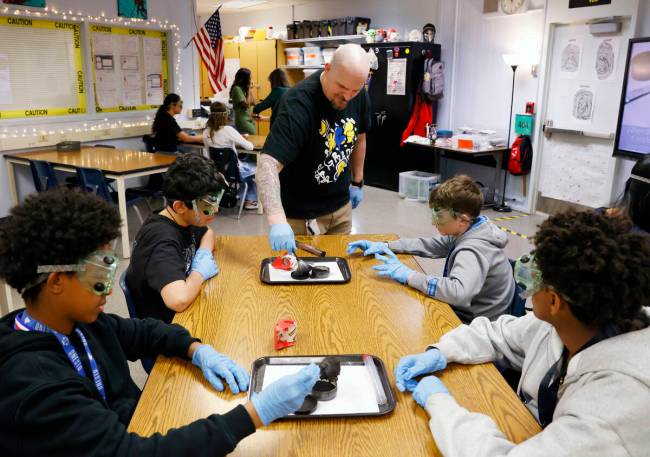
Classes at Guinn STEM Academy are unlike nearly any other middle school.
Some of the computer design students become digital artists for an hour, hunched over laptops rendering their custom 3D models of foods.
In a forensics classroom adorned with student-made missing person posters and blood-splatter analysis projects, others turn into amateur investigators learning how to dust for fingerprints.
Both classes are offered through Guinn’s magnet program, one of 45 in the Clark County School District that teach specialized, themed curriculum to students selected through a competitive lottery system.
DISTRICT IN DECLINE
Magnet schools and programs are increasingly popular education paths in Southern Nevada and may hold the answer to bringing kids back into Clark County public school classrooms.
Enrollment declines have plagued a large swath of the Clark County School District over the last decade, but among 43 schools in the district that have seen enrollment increase and been open for 10 or more years, 24 have magnet programs.
Of those, 17 offer either science, technology, engineering and mathematics programs or are career and technical academies.

“Our magnet schools are really kind of the original form of school choice,” said Gia Moore, assistant superintendent of college and career readiness and school choice. “That’s what our parents want. They want choice.”
Schools that receive a magnet program even tend to see a sustained uptick in enrollment, according to Rick Baldwin, the district’s director of comprehensive planning.
Students return to the school district just to enroll in its high school magnet programs and career and technical academies, Baldwin said. Student enrollment increases an average of almost 10 percent between eighth and ninth grade, he said, with most newcomers enrolling in magnet programs or career and technical academies.
Our magnet schools are really kind of the original form of school choice. That’s what our parents want. They want choice.
Baldwin said he sees creating more choice programs across the district as a potential solution to help mitigate further enrollment decline.
“Those are the programs that those families want coming back from charters, back from private schools,” Baldwin said. “That data has shown and kind of fostered that desire to increase those programs. That’s what parents are requesting. That’s what they want to see. That’s what students want to see.”

‘A little bit less traditional’
Enrollment is rising at Guinn STEM Academy, located in Spring Valley.
The school is one of only 11 Clark County middle schools that have seen enrollment rise over the past 10 years. It now boasts 1,066 students, up from the 900 students it had in the 2015-16 school year when its magnet program was established.
Asked what draws students and parents to Guinn, Principal Erin Rolfe said many parents point to the breadth of classes unlikely to be found at other middle schools.
This includes Guinn’s space and flight class. Taught by an Air Force veteran, groups of students work on projects such as designing sustainable moon bases or building solar-powered ovens out of cardboard boxes and mylar sheets.

A flight simulator near the classroom’s door even lets students try their hand at operating a host of virtual aircraft.
“Maybe what parents are looking for is they want something a little bit less traditional. I’m not afraid to push down that lane,” she said.
Part of the reason for the specialized curriculum, Rolfe said, is to introduce students to unfamiliar fields and career options. But the classes are also aimed at teaching problem-solving skills, she said. Students tasked with building solar ovens, for example, must figure out how to apply lessons taught in the classroom to a real-world project.
“We want them to look at problems and analyze them through a lens of, ‘How do I figure this out?’ as opposed to, ‘I can’t figure this out,’” Rolfe said. “STEM isn’t about science, technology, engineering or mathematics. It’s really just a way of thinking about things.”
This way of teaching keeps students more engaged and helps them better visualize theoretical concepts, according to Emily McDonald-Williams, director of the STEM education program at the Desert Research Institute.
Maybe what parents are looking for is they want something a little bit less traditional. I’m not afraid to push down that lane.
Research shows that students tend to determine by third grade whether they’re good at STEM subjects, McDonald-Williams said, so building a strong foundation early in a student’s life can pay dividends for their learning confidence — and their potential paychecks.
“We know that STEM careers typically have higher incomes later in life and larger earning potentials, so seeing students self-select out of these fields at such a young age is problematic,” McDonald-Williams said.

Certification pathways open doors
The district has opened more seats for its choice programs in recent years, but getting into any of the district’s STEM-centered schools or career and technical academies remains a challenge.
According to a district spokesperson, the school district received 25,792 applications for a chance at the 14,150 seats it offered in magnet and career and technical programs this school year.
At East Career and Technical Academy, Principal Natasha LeRutte said her school received nearly 2,100 applications to fill about 520 open seats this school year. The school has specialized education programs that prepare students to work in fields such as early childhood education, sports medicine, culinary arts and construction.
Part of the high demand to enroll at East CTA, LeRutte said, was the school’s history of success, often achieving a 100 percent graduation rate and a 100 percent college acceptance rate. For kids who aren’t college-bound, the school offers hands-on practice and certifications that can kickstart their careers, according to Jayme Rawson, the achievement coach at East CTA.

Aspiring chefs can earn certifications from the American Culinary Federation, prospective teachers can help run the on-campus preschool and the school’s welding instructor is qualified to grant students welding certifications — all experiences and resume builders that most students would have to pay for out-of-pocket after high school.
“Our students can walk away with those certifications in their hand with their diploma, and then if they’d like to go enter the industry … they can do that right away,” LeRutte said.
While most traditional schools with dwindling enrollment and budget constraints likely cannot afford to offer trade-oriented classes, LeRutte said many schools could emulate East CTA’s student ambassador program.
Student ambassadors recruit eighth graders to East CTA through campus tours where they share their high school experiences, LeRutte said. Rawson added that through the program, kids learn leadership and public speaking skills.
Our students can walk away with those certifications in their hand with their diploma, and then if they’d like to go enter the industry … they can do that right away.
Student ambassadors have generated increased excitement from incoming students, all for the minimal cost of paying one educator to teach the class during their planning, LeRutte said.
As schools across the valley struggle with enrollment losses, LeRutte suggested that students themselves may know how to best convince their peers to stay in a district school.
“We’re not going to know exactly what is going to catch an eighth grader’s eye, but they do,” LeRutte said.
Contact Spencer Levering at slevering@reviewjournal.com or 702-383-0253.