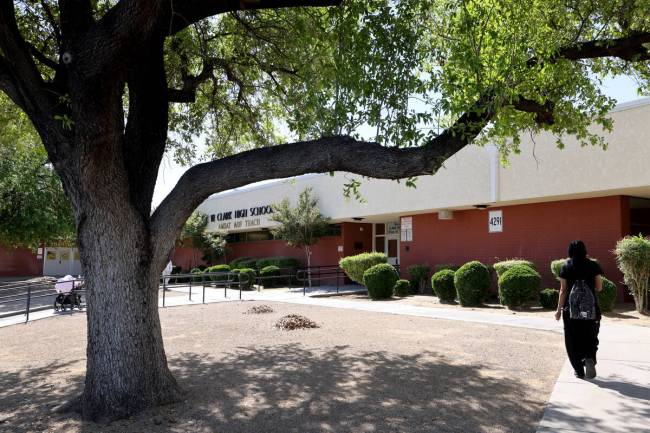
The historic halls of Clark High School in the central Las Vegas Valley aren’t as full as they were when junior Alex Martinez Vaca started attending classes there.
Once-packed cafeteria seats now remain empty, he said as a handful of his remaining classmates trickled through Clark’s wide, pale yellow-tiled hallways.
“At lunch, you can notice less crowds,” Martinez Vaca said. “It used to be really full and stuff, but not much anymore.”
Like most schools in the Clark County School District, Clark High School’s student enrollment has declined over the last decade. Enrollment at Clark peaked at 3,411 students in the 2020-21 school year but has fallen to 2,721 this year — a nearly 700 student drop. Clark is expected to lose another 88 students over the next five years, district data shows.
DISTRICT IN DECLINE
Clark High School Principal Zeola Braxton, like her students, has watched the 61-year-old school’s enrollment shrink in real-time. She arrived at Clark during its enrollment apex and said the school has steadily lost about 100 students per year since, a change she attributed to a high transiency rate among families in its attendance zone.
Braxton said declining enrollment has forced Clark High School to become more mindful in planning its annual budget, eschewing large purchases or changing which subjects educators teach to retain her staff. When school employees leave their jobs, Braxton said, Clark’s staff downsizes, and she does not hire new people to fill their positions.

“Maybe we don’t buy as many glue sticks. Maybe we don’t buy that big piece of equipment that we were looking and saving for,” Braxton said. “Those are sacrifices that I’m willing to make. I’m not willing to make them on people, if I don’t have to.”
But by closely monitoring projected enrollment count at least a year in advance, Braxton said, Clark High School is in a better position to stave off deep cuts to staffing and school programs.
“Even though the funding has declined a little bit, we’ve been able to save our money and be wise with our money,” she said.
Clark hasn’t discontinued any extracurricular activities or classes as enrollment has fallen, Braxton said, something she sees as important to keep its current students coming back each day.
“The experiences that (students) have here … they take that out into the real world,” Braxton said. “Whether we have the money, whether we don’t have the money, they’re going to remember that person, or that program, that cared about them.”

Why is CCSD enrollment dropping?
The district’s comprehensive planner, Rick Baldwin, points to falling birth rates as the primary reason for the drops district wide.
Clark County births per year in this century dipped to 24,036 in 2024, down from a peak of 30,772 in 2007, according to data obtained from the Southern Nevada Health District.
There were more than 25,000 graduates in the class of 2025 — the last cohort born before the Great Recession ushered in lower birth rates — but only 17,678 new kindergarteners this school year, he said.
The school district is also struggling to attract and retain students in this shrinking pool, Baldwin said.
Only 68 percent of all kindergarten-aged kids born in Clark County enrolled in the school district this school year, he said, a far cry from the early 2000s when capture rate occasionally topped 100 percent.
Maybe we don’t buy as many glue sticks. Maybe we don’t buy that big piece of equipment that we were looking and saving for. Those are sacrifices that I’m willing to make. I’m not willing to make them on people, if I don’t have to.
“In the early 2000s — that’s when we were growing — we were seeing more students coming into CCSD than those who were even born here,” Baldwin said. “And that’s changed substantially.”
Out-migration — a measure of how many students who were enrolled in CCSD last year but not enrolled this year — reached a level this school year that has not been seen since the statistic peaked during the COVID-19 pandemic, Baldwin said.

Excluding graduating seniors, Baldwin’s data shows there were 25,641 students who were enrolled in the school district last school year who did not return to classes.
Baldwin said an increasing number of parents are turning to public school alternatives.
State data shows charter school enrollment in Nevada grew to 63,609 students in the 2024-25 school year, up from 25,748 in the 2015-16 school year. Nevada’s private schools have also seen modest growth, gaining about 3,000 students since the pandemic, according to Nevada Department of Education data.
In the early 2000s — that’s when we were growing — we were seeing more students coming into CCSD than those who were even born here. And that’s changed substantially.
However, Baldwin challenged the notion that charter school growth is a primary factor in the school district’s enrollment decline.
“Their growth did not equal our loss by any means,” Baldwin said of charter school enrollment trends in recent years.
Contact Spencer Levering at slevering@reviewjournal.com or 702-383-0253.