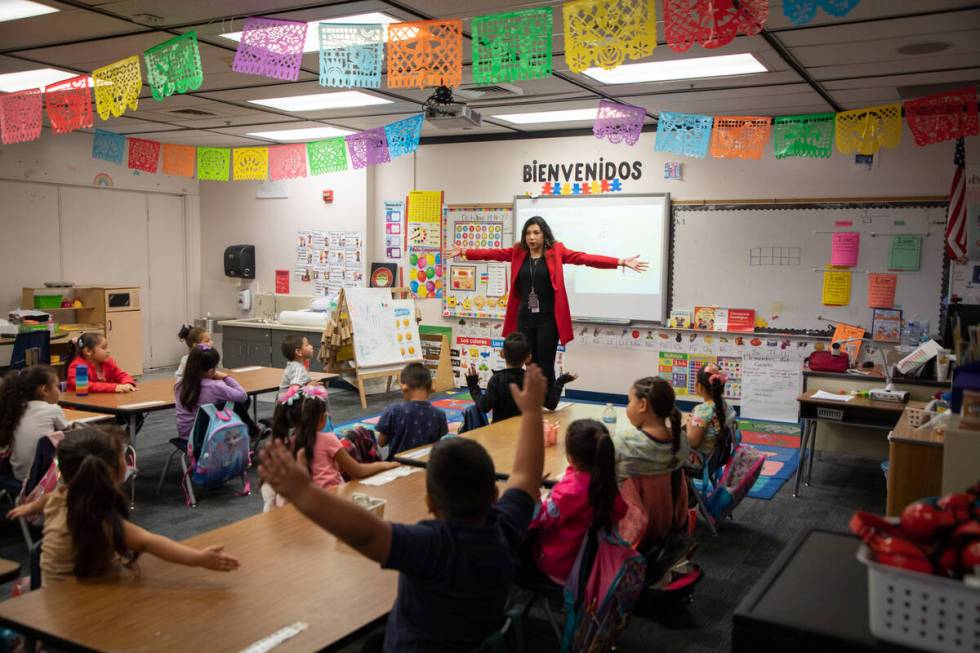
For decades, the Clark County School District was one of the fastest growing school systems in the nation, buoyed by a booming gaming and tourism industry and low housing costs.
Just seven years ago, when enrollment peaked, the district boasted 335,333 students in its classrooms.
Then came the decline.
DISTRICT IN DECLINE
The pandemic spurred lower birth rates, economic turbulence for families, and a rise in the popularity of public-school alternatives in Southern Nevada. The district that could not grow fast enough is now shrinking.
This year, the district enrolled 291,587 students, a drop of nearly 44,000 from the height during the 2018-19 school year, according to Nevada Department of Education data.
“It’s a substantial dichotomy from what they’re used to for two plus decades, three decades,” said Rick Baldwin, the district’s director of comprehensive planning. “Now we’re going in the opposite direction, and people are struggling with that realization.”

East Las Vegas elementaries see big enrollment dips
Enrollment fell at 229 of the district’s 303 elementary, middle and high schools that have been open for the last 10 school years, according to Nevada Department of Education data. Elementary and middle schools have averaged around 160 fewer students per school, while high schools have averaged around 85 fewer students per school.
East Las Vegas and its surrounding neighborhoods are home to nine of the 10 elementary schools with the largest enrollment drops. All have upward of 350 fewer students now than they did 10 years ago, and most are identified as potential candidates for replacement, renovations, consolidation or closure under a preliminary report by the school district.
Data shows the greatest enrollment losses at the elementary level are concentrated in some of the county’s poorest ZIP codes, affecting students who have some of the greatest needs for more educational resources.
The Las Vegas Review-Journal analyzed enrollment at only PK-5, K-5, 6-8 and 9-12 schools, which make up the majority of schools in the district, and removed schools with sudden single-year enrollment drops that could have been caused by a new CCSD school opening near their attendance zone. Five rural schools with incomplete enrollment data from the state also were not included in the Review-Journal’s analysis.
It’s a substantial dichotomy from what they’re used to for two plus decades, three decades. Now we’re going in the opposite direction, and people are struggling with that realization.
The 10 elementary schools with the steepest enrollment declines reside in ZIP codes with an average median income of $48,945 in 2024, well below the Clark County median income of $80,028 that same year, according to U.S. Census Bureau data. The 15 elementary schools that saw natural enrollment increases, meanwhile, are in ZIP codes with an average median income of $76,757.
When enrollment plummets at schools in economically disadvantaged areas like East Las Vegas, a downward spiral can leave poorer students with a less holistic education, according to Amanda Morgan, executive director of the nonpartisan education policy group Educate Nevada Now.
“You have a community that’s been disinvested in, (and) they’re experiencing economic hardship which has been exacerbated, especially here in Southern Nevada, with decline in economic opportunity and rising costs,” Morgan said.
Megan Griffard, assistant professor of educational policy and leadership at UNLV, said about 85 percent of the average school’s budget is spent on salaries and benefits for school employees, while the remaining 15 percent goes toward purchasing instructional supplies and other school services.
As school budgets shrink to match enrollment, Morgan said, cuts tend to first target specialty programs like music, arts or sports, which have proven to entice students to attend school and improve academic outcomes in other subjects.
“All students deserve to have those types of programs,” Morgan said. “It increases engagement, it makes students happier … and it also makes the school more desirable.”

Fewer resources, more demand
Inside schools in low-income neighborhoods, staff are asked to stretch funds to meet the pressing needs students have both inside and outside the classroom, according to Tim Hughes, vice president on the Nevada State Board of Education and executive director of Teach For America Nevada.
Most of the organization’s Clark County educators work in federally funded schools throughout North Las Vegas and East Las Vegas, Hughes said.
They tell him many students are multiple grade levels behind academically.
Some are entering kindergarten without knowing the alphabet or how to write their name, Hughes said, a trend he attributed to the lack of pre-K programs in low-income neighborhoods.
At the same time, he said, schools are trying to meet students’ basic food and clothing needs.
“The fewer resources, the fewer people you have in those buildings, the harder it is to continue to try to fill those gaps,” Hughes said.
You have a community that’s been disinvested in, (and) they’re experiencing economic hardship which has been exacerbated, especially here in Southern Nevada, with decline in economic opportunity and rising costs.
Enrollment decline follows a national trend, and Hughes said low-income students could be most affected because they have fewer opportunities in their neighborhoods to supplement their education once classes let out.
“Many affluent families are going out of their own pockets, paying for tutoring, paying for academic services, intervention, college prep, all those sorts of things,” Hughes said. “One challenge many low-income students face is, they don’t have readily accessible resources like that that are going to help propel them in their education journey.”
Weighted per-pupil funding should address these disparities, but Hughes said the limited pool these funds pull from is “certainly not adequate yet.”
If schools don’t have ample students eligible for at-risk or English learner funding, he said, it may not make financial sense for them to offer programs that could meet those students’ needs.
“We’re on the right track, but we’re still trying to split a pie that is not big enough,” Hughes said.
Contact Spencer Levering at slevering@reviewjournal.com or 702-383-0253.