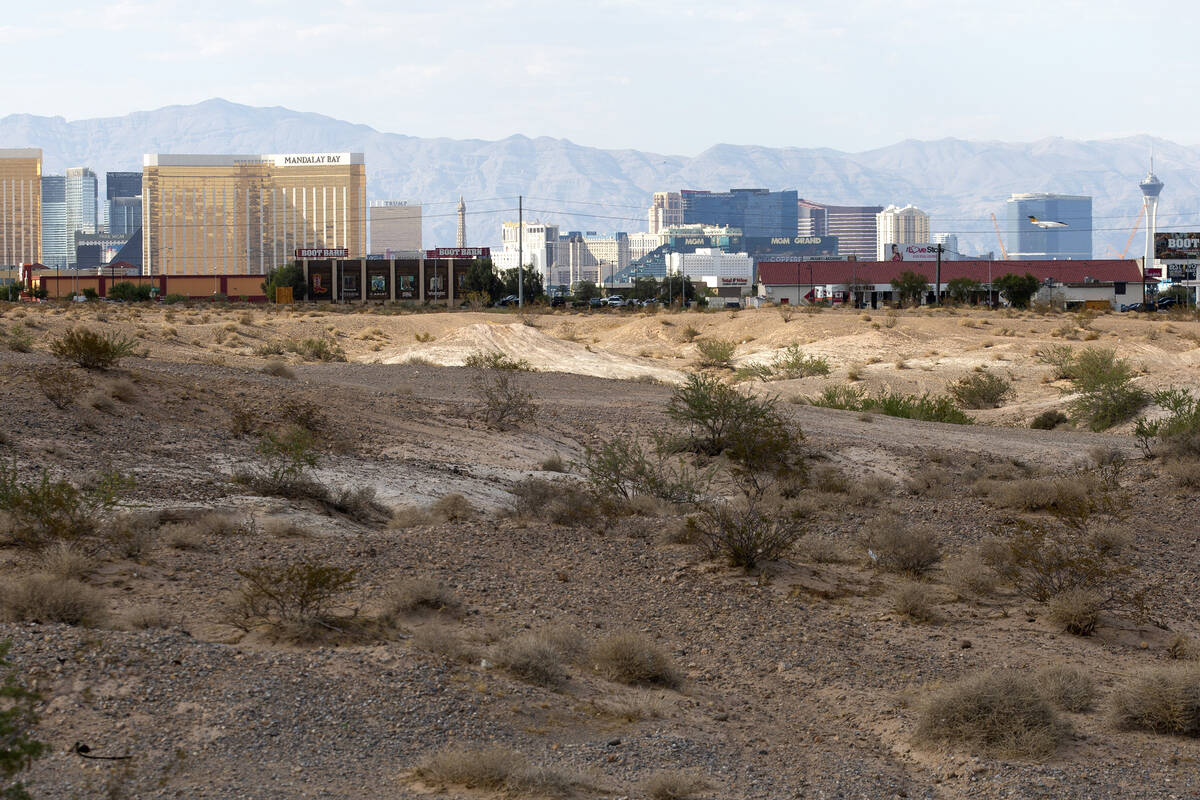
The federal government’s restrictive control of a fair chunk of the remaining land left for development in the Las Vegas Valley is now weighing heavily on the region’s housing market, according to multiple sources.
Only 41.8 acres in the Las Vegas Valley were purchased from the federal government last year, the lowest total the Bureau of Land Management in Southern Nevada has offloaded since the Great Recession.
Multifamily builders and brokers, along with private homebuilders have been sounding the alarm for years on the lack of land available to develop within the valley as driving up home prices and the cost of living.
Jeffrey Swinger, an executive vice president for multifamily investment sales with commercial real estate brokerage Colliers in Las Vegas, said the local market has to deal with this added layer of bureaucracy that no other metro in the country does.
Most of the land left for development in Southern Nevada is controlled by the Bureau of Land Management, and the agency has been slow to release it via a bureaucratic and cumbersome nomination process dating back decades.
Swinger said this brings the fundamental economic issue of supply and demand into the valley’s multifamily construction market, as multiple commercial brokers who have spoken to the Las Vegas Review-Journal said the federal government’s price tag for the land is too high.
“The government’s policy regarding releasing available BLM land for development just exasperates the problem,” he said in an email response to the Las Vegas Review-Journal. “The decreasing supply of private, developable land in Las Vegas will continue to be a problem as Las Vegas grows.”
In a recent report titled “When America (and Nevada) Works, Prosperity Happens: The Essential Connection Between a Job Market and Economic Health,” local economic analyst John Restrepo laid out the state’s structural economic vulnerabilities.
“Federal land ownership constrains Nevada’s development options,” the report said. “Approximately 85 percent of Nevada’s land is federally owned, dramatically limiting areas available for residential, commercial, or industrial development.”
The BLM confirmed 76 acres were put up for auction at a “fair market value” last year, with nearly half selling for $16.5 million, an average price per acre of $396,000. That’s the highest price per acre offered by the BLM to the private sector since 2008, according to official figures on the BLM’s website. This year the agency has offloaded more than 100 acres for nearly $70 million to private buyers in an auction.
Steven Haynes, a vice president with Colliers, said land offered at auction by the BLM often doesn’t make financial sense for potential projects so the private sector simply doesn’t nominate much federal land for auction. It’s also challenging for developers, he said, because the land must be nominated for sale, and if the bid is successful, 20 percent of the purchase price is required up front and the rest has to be paid within 180 days of the sale.
“The problem is there’s no way within that timeframe you’re even going to get a tentative site map done, or anything approved in six months at the county or municipal level, it’s impossible,” said Haynes. “I think this is all a combination of the shape of some of the land they’re offloading, the price and just the general bureaucracy,” he added.
Nicholas Irwin, research director with UNLV’s Lied Center for Real Estate, said it’s clear the private sector doesn’t have much appetite for federal land anymore due to it’s bureaucratic process and unreasonable sales prices.
“This is certainly a concern because the issue is how do you motivate the federal government to do anything?”
Political action?
The federal government may not have the best handle on how much land they actually own in Nevada, Gov. Joe Lombardo said at a recent housing outlook panel hosted by Home Builders Research. Lombardo said he’s been working on the issue at both the local, county, state and federal level for a few years now, and at the outset faced a rather glaring issue.
“The federal government didn’t know what land they owned,” he said, “and that sounds funny right? But it’s sad, it’s sad that they didn’t know.”
Assemblymember Lisa Cole, a Republican from District 4 in Clark County, confirmed she was part of a Federal Public Sector Working Group, made of primarily developers and Las Vegas Global Economic Alliance members that first met last year and have since been pulled into the newly formed governor’s housing committee group.
The new group has several subcommittees, one of them trying to find a way to streamline BLM land and offload it to the private sector, or at least the county or municipalities, she said. Cole added this is a problem unique to the valley and working with the federal government up until this point has been frustrating. She said there is clearly a divide between what the government wants for the land, and what the private sector is willing to pay for it.
“Federal land ownership within the metropolitan area, the way that we are dealing with in the Clark County area, I don’t know anyone else that is in this situation,” Cole said. “Part of the issue is the fair market value that the federal government insists on getting for these properties, and the way in which the appraisals happen has been problematic.”
These bureaucratic bottlenecks need to be cleaned up to unlock the land, said David Edelblute, a government relations attorney.
“Even after the local nomination process, the BLM process of external surveys, environmental review, appraisals, lengthy notice periods, and other steps delay the public land sales by design,” he said. “The Trump administration has sought to speed these processes up, but we are not seeing an immediate impact in those areas.”
The Review-Journal reached out to the Southern Nevada District office on the low level of land for sale last year, however Rita Henderson, a public affairs officer for the BLM, simply directed the newspaper to a 2025 press release for its last sale of land.
Contact Patrick Blennerhassett at pblennerhassett@reviewjournal.com.