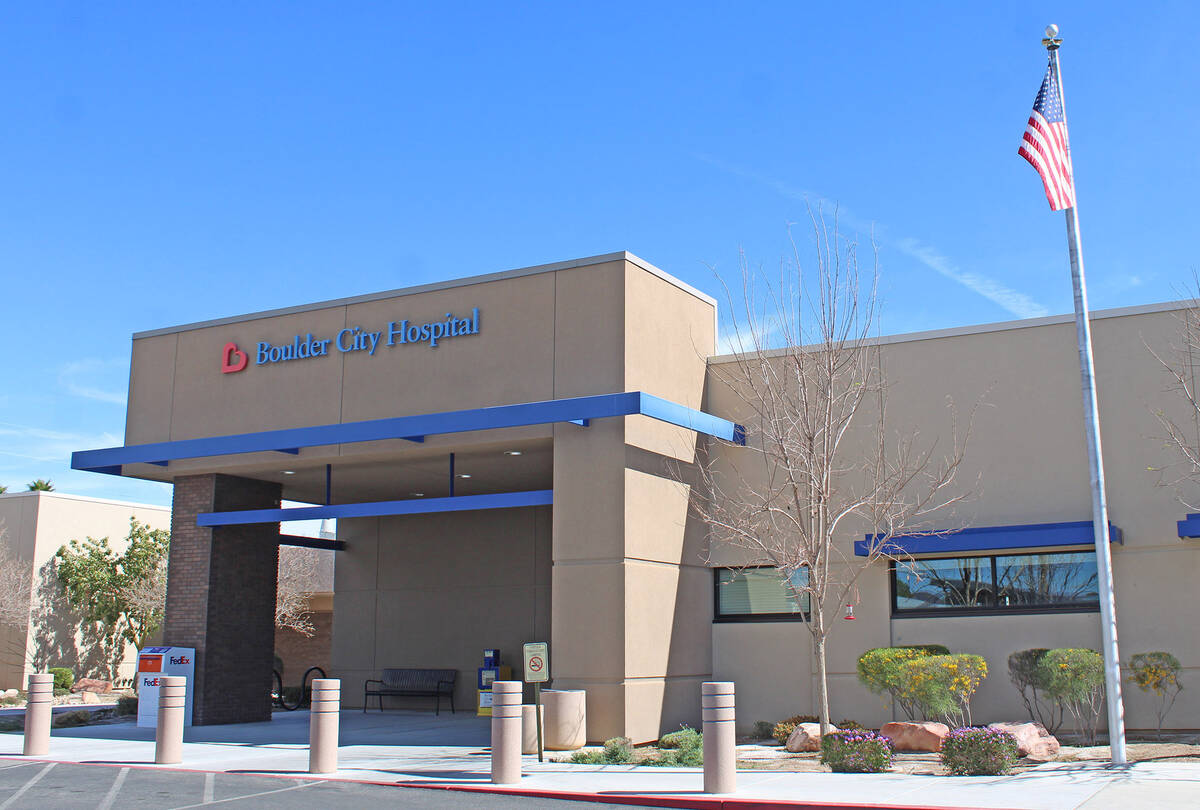
Some major changes are coming soon to Boulder City Hospital, including dozens of layoffs and the end of inpatient care.
It was announced on Feb. 27 that it would be transitioning to a rural emergency hospital effective May 1. According to information released by the hospital, this transition is designed to ensure that essential health care services remain available and sustainable for the community for years to come.
In an interview Monday with the Boulder City Review, hospital CEO Thomas Maher said he understands that the change may have some residents concerned.
“The important message is that we’re assuring people that important health care services will remain in Boulder City for the long term,” he said.
According to the hospital, a rural emergency hospital is a new Medicare provider type created to keep essential 24/7 emergency care, lab services, radiology and outpatient services available in rural areas facing financial hardship or potential hospital closures.
This model does not include inpatient hospital beds, but it prioritizes rapid emergency care, stabilization and seamless transfer to partner hospitals when inpatient admission is needed.
Patients who need to be hospitalized longer than 24 hours will be given the option to choose which hospital in the Vegas Valley they wish to be moved to, based upon their needs and available beds.
Some of this may be determined by insurance coverage, Maher explained. If the patient is not able to articulate a preference, the emergency room physician will make that decision, again, based on the patient’s medical needs and space availability.
The closure of inpatient care services is expected to be permanent.
What’s remaining
In addition to emergency room services, the long-term, 47-bed care facility will remain. Other services that will continue to be available include:
— the primary care clinic.
— laboratory services.
— rehabilitation therapy.
— radiology.
— community resources.
— respiratory therapy.
— 0utpatient behavioral health.
— outpatient surgery.
Loss of jobs
In all, around 70 part-and full-time employees will be losing their jobs. The majority of those work within the departments that are being cut.
“It’s absolutely the worst part of this job,” Maher said. “Any time you have a reduction in force, sadly, good people often lose their jobs. I’ve been here for 19 years and have gotten to know a lot of the employees. We have some who have been here 20 and even 30 years.”
How this came about
This status change was made available in 2020 to critical access hospitals and small rural hospitals with fewer than 50 beds. Each rural emergency hospital receives a fixed monthly payment from Medicare, regardless of patient volume. In 2026, this is $295,000 per month or more than $3.54 million annually, the hospital stated.
“This particular option was first brought up in October and more fully vetted out at our December board meeting,” Maher told the Review. “The viability of the hospital, for a long time, has been a concern of mine and the board’s. We were searching for a way to ensure we have a long-term viable health care option in Boulder City.”
That search has continued during Maher’s nearly two-decade tenure at Boulder City Hospital. He said the hospital would have been in the situation it is now more than five years ago had it not received American Rescue Plan Act funds post-COVID, which kept it afloat financially.
As to the change, information provided by the hospital states the following:
— This redefines the rural hospital, focusing on urgent needs rather than inpatient stays, preserving crucial health care access in underserved communities.
— It allows small facilities to continue providing emergency and outpatient care while eliminating costly inpatient services.
— As of early 2026, dozens of hospitals have converted to this status to preserve essential local health care access in communities where full-service hospitals are no longer financially sustainable.
— Struggling hospitals with low inpatient volumes often convert to rural emergency hospital status to eliminate the high overhead of maintaining 24/7 inpatient staffing.
Critical access hospitals are facing closure because they operate on thin margins in low-volume markets, face low and inconsistent reimbursement from payers, struggle with workforce shortages, are slow to pay vendor and loan obligations, and carry high fixed costs. This all comes against a backdrop of demographic and policy pressures that make long-term financial viability hard to achieve, the hospital information stated.
Some critical access hospitals are not closing outright but rather switching to different designations, such as rural emergency hospitals, which allow emergency care without inpatient beds to improve reimbursement.
Although reclassification to a rural emergency hospital comes with payer and reimbursement advantages, this does not always solve financial pressures, and many facilities still risk shutting down, the hospital said.
Maher said that while the decision was not an easy one, becoming a rural hospital in the long term will assist in keeping the hospital open, which has not been the case for others of similar size across the country.
“We never wanted it to get to this point, but we’ve been looking at options and strategies for the past two decades,” he said. “Becoming a rural emergency hospital is life-saving for many critical access hospitals in the country that are not making it financially.”