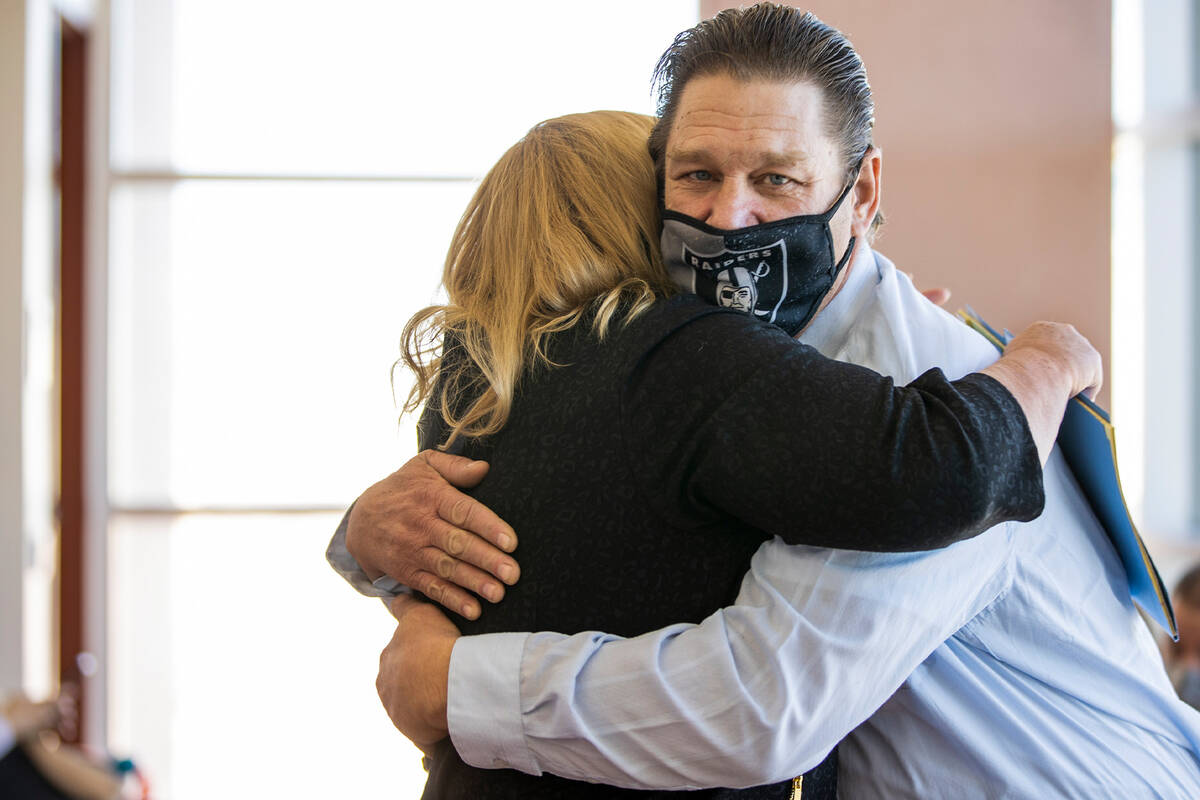
Multiple Las Vegas judges declared that Fred Steese was innocent. One approved a roughly $1.4 million settlement payment to him after Nevada authorities issued a pardon.
For a man who had once faced the death penalty for a 1992 murder he did not commit, those were monumental victories.
But Steese’s life after prison was troubled.
His sister and attorney think he spent the settlement money. He struggled with bouts of homelessness, battled substance abuse and sometimes was used by people who took advantage of his trusting nature, his sister said.
Steese died last month. He was 62 and suffering from pancreatic cancer that had metastasized to his liver, according to Lynn Myers, his older sister.
The events of Steese’s case influenced the careers and beliefs of those involved.
They led to allegations of prosecutorial misconduct.
They left the victim’s sister searching for answers about what really happened to her brother.
They led now-Clark County Public Defender Nancy Lemcke, who represented Steese at trial as a young lawyer, to abandon a planned career in business law and become a public defender.
“While I believe that our system is without question the best in the world, I learned that it’s not infallible,” she said.
Trial and innocence finding
Steese was convicted in 1995 of the fatal stabbing of Gerard Soules, a 56-year-old former trapeze artist who ran a dog show at Circus Circus.
At trial, Steese’s attorneys presented an alibi defense: that he was in Idaho at the time of Soules’ death, according to a 2012 innocence order signed by then-District Judge Elissa Cadish.
The prosecution argued that the person in Idaho was really Fred Steese’s brother Robert Steese, who lived in Texas and would testify in 2011 that he knew nothing about what Fred Steese was doing at the time of the killing, the order said.
Cadish’s order said that there was strong evidence contrary to the claim Robert Steese was the person in Idaho at the time. Evidence “establishes a well-documented alibi proven by multiple consistent and reliable sources,” the judge found.
Steese was prosecuted by Bill Kephart, who became a District Court judge, and Doug Herndon, now the chief justice of the Nevada Supreme Court.
A homeless drifter who had stayed with Soules until shortly before his death, Steese was in Indiana when North Las Vegas police contacted him after a letter for him arrived at Soules’ trailer. Steese returned to Nevada and confessed to the murder after giving multiple different versions of what happened.
Cadish’s order raised questions about the confession, noting that Steese had a low IQ and provided contradictory accounts.
Steese had faced the death penalty, but agreed to a life without parole sentence following jurors’ guilty verdict.
After the trial, defense attorneys argued that prosecutors had unlawfully withheld exculpatory evidence and intimidated witnesses. Prosecutors denied that they had committed any misconduct and at the time, Steese’s claims were unsuccessful in winning him a new trial.
Cadish’s order noted that much of the new evidence presented before she made the innocence finding “became available to the defense as a result of the Court’s May 2011 order authorizing discovery of the district attorney’s file.”
Despite Cadish’s finding that he was actually innocent, Steese made an Alford guilty plea to second-degree murder to gain his freedom. An Alford plea allows a defendant to maintain innocence while acknowledging prosecutors could prove their case.
Steese was pardoned in 2017. In 2021, District Judge Jasmin Lilly-Spells signed off on his settlement with the state and a certificate of innocence.
Who killed Soules?
Kathleen Soules Nasrey, the victim’s younger sister, supported Steese’s successful effort to be cleared by the Nevada Board of Pardon Commissioners and is convinced that he did not kill her brother after previously believing the opposite.
Now 76 and living in Michigan, she is critical of the way law enforcement handled the case and wants answers about who was responsible for her brother’s brutal death.
“I would like to know why,” she said in a phone interview. “I mean, I’m sure I’ll never find out.”
North Las Vegas police did not immediately answer questions about whether they consider the case open or unsolved; a spokesperson said Friday that staff have a four-day work week and supervisors who could provide that information would return Monday.
Police acknowledged in a statement that Steese did not commit the crime and said they extend sympathy to all affected.
The Clark County district attorney’s office said prosecutors are unaware of any new leads or additional evidence.
Ryan Norwood, the federal public defender who helped Steese win the innocence finding, said the case is now “very cold.” He thinks Steese was prosecuted largely because authorities did not know who else could have committed the killing.
“One of the tragedies of Fred’s case is because he was wrongfully convicted and because that continued for so long, that the person who actually did kill (Soules) was never investigated and it’s probably too late to do so now,” he said.
‘That mistake informs me every day’
In the years after Steese’s conviction, attorneys involved in his case enjoyed successful careers.
Lemcke became the head of the public defender’s office. Kephart and Herndon became judges.
Since Steese’s exoneration, election opponents for both men have used the case to campaign against them.
“I’m telling you right now, I have no regrets,” Kephart said while running for re-election in 2020. “I’m telling you right now, there’s a murderer out in our public.”
He lost to now-District Judge Crystal Eller.
Herndon, a second chair junior prosecutor at trial, has been more reflective, while also arguing that no misconduct was found in Steese’s case.
He supported legislation in 2019 that created a path to compensation for people in Nevada who have been wrongfully convicted.
“I have a unique perspective on and placement in this process as a prosecutor involved in a case in which a man was convicted of murder but later found to be factually innocent,” he testified at the time. “If you think that does not weigh heavily on someone, you are mistaken. That mistake informs me every day that I do my job about the failings that can occur within our justice system.”
He said this week that he still stands by his prior testimony.
Life after prison
Attorney Lisa Rasmussen represented Steese after his 2013 release and tried to take care of him before he received compensation, sometimes buying him groceries or sending her husband to purchase shoes for him.
“I’m very sad that he’s gone,” she said. “He wasn’t that old. He had a very hard life.”
Steese’s family was fragmented, said Myers, his sister with whom he shared a biological mother.
His father worked for an oil company and the family moved frequently, she said, bouncing between Oregon, Texas and California.
Her biological mother gave her up when she was a baby, she said. Steese stayed with his parents, who at one point abandoned him and his brother, she said he later told her.
“Fred took care of his little brother for as long as he could until people started noticing that he was knocking on doors and asking for food for them,” she said.
He was placed in foster care, she said, but would run away from his foster homes. She said he eventually reunited with his mother.
She and Steese connected with each other as middle-aged adults while he was still imprisoned and began a relationship by letter and phone. She found him through another sister whom she met via an Ancestry.com message board.
He stayed with Myers after his release.
A free spirit, Steese fulfilled his dream of becoming a trucker after he left prison.
He told the Las Vegas Review-Journal of other dreams for his life following the settlement money: riding across the desert on a new dirt bike, hunting and fishing, a new home with a garage, a new truck, a cruise to Italy.
“I want to stay busy,” he said at the time. “I’ll probably just do stuff that I like to do, you know, now that I don’t have to worry about my rent or how I’m going to eat.”
Once he received the funds, he bought trucks and a Shelby Mustang, according to Myers. He also found a 22-year-old girlfriend, she said, and struggled with drug use. He had trouble maintaining relationships.
“He just never was a person that stayed still very long, or he would make connections but he wouldn’t keep them very long sometimes and I think that’s the part that hurt him the most,” she said.
Eventually, she said, “He lost everything and he ended up back on the street.”
Rasmussen last spoke with Steese sometime around 2024.
“It wasn’t great because he was struggling and really didn’t have any of his money left and it was frustrating,” she said.
She added: “Fred had a way of always helping people and doing things for other people and I suspect he spent a lot of his money on other people and that probably brought him joy, because he had never been in that position.”
Steese maintained the ability to draw people to him.
“He was just such a friendly, personable guy that just about everybody that met him loved him,” Myers said.
Complications from a hernia operation led to a series of other surgeries in May and June, she said. Steese was homeless at the time, occasionally staying with an acquaintance in Pahrump.
Testing revealed that Steese had cancer and he went into hospice. His death was peaceful, Myers said.
She cries when she speaks about him.
“I still love him, I’ll never stop loving him,” she said. “He’s my baby brother. I’ll always miss him.”
Contact Noble Brigham at nbrigham@reviewjournal.com.