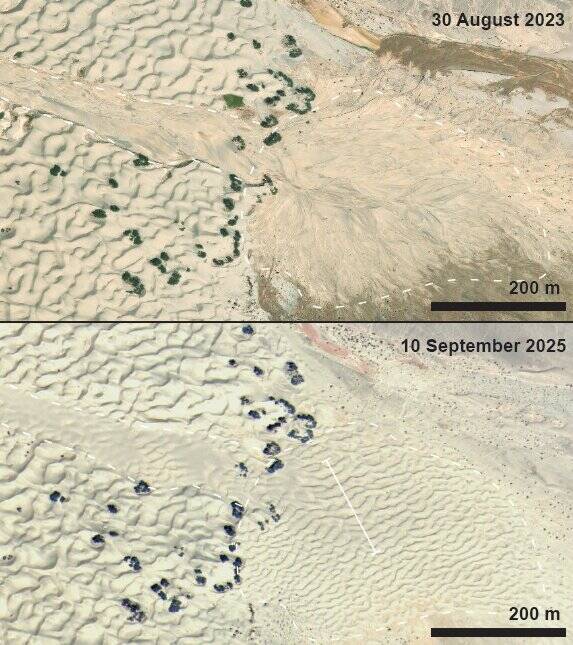
The remarkable recovery of dunes in Death Valley after some were obliterated by remnants of a hurricane may offer clues to how scientists should interpret rocks to study ancient flooding, new research suggests.
The study, published in the Journal of Geophysical Research by a lab based at the University of California, Los Angeles, tracks the rebuilding of Mesquite Flat Sand Dunes after Hurricane Hilary in 2023, the remnants of a storm that brought a year’s worth of rain to Death Valley National Park in a single day.
“Understanding all of this helps us learn about the past and other planets,” said Alana Archbold, a graduate student at UCLA and a study author, in an interview. “It’s preparation for communities, too, especially as the Earth gets hotter and drier.”
Hilary’s flood damage in most corners of the park was catastrophic. While most of Mesquite Dunes did not wash away, water rushed more than a mile into the dune field, leaving behind mud.
Over the course of their observations, the team found that the Mesquite Flat Sand Dunes had seen impressive changes in the year and a half since the storm. In one area, where 1.3 million tons of sand had been removed by the flood, roughly 1.5 million tons had built up in new “baby dunes” downstream.
The Mesquite Flat Sand Dunes are about a 2½-hour drive northwest of Las Vegas.
Another channel cut into the dunes by floodwater was already partly filled with sand 65 days after the storm and was almost completely filled by December 2024, as wind-blown sand gradually smoothed the landscape, the study shows.
Gaps in the ‘rock record’

Dunes and other sediment deposits have long been thought to provide clues about climate conditions dating back millions of years. Scientists refer to the geological record preserved in the landscape as the “rock record,” and it’s not always reliable, says Jordan Bretzfelder, a UCLA graduate and study author who went on to work for NASA’s Marshall Space Flight Center in Alabama.
“There are areas all over the world where we know there are unconformities, or areas where there is a gap in the rock record, due to higher erosion of the material that was deposited or lack of deposition during that time,” Bretzfelder said. “We don’t know anything about hundreds of millions of years because of these gaps.”
Bretzfelder and her adviser at NASA, Michael Zanetti, used a unique LiDAR — an acronym for light detection and ranging — tool that provided highly accurate, 3D and centimeter-level data of the dune area. Because of restrictions on drone flights in national parks, it allowed scientists a ground-level way to gather information, she said.
The dune landscape’s quick removal of evidence that Hilary occurred suggests extreme flooding may leave a much more fragmented and difficult-to-recognize signature in the rock record than scientists might expect from the size of the event.
Archbold said being able to collect data on such a significant flooding event in North America’s driest and hottest place is novel. And the findings challenged her initial hypothesis, she said.
“I would have expected a flood event this ginormous in such a dry area to really make an impact in the rock record, but from what we have seen, it appears that it won’t show up as majorly as I thought,” Archbold said.
Could Death Valley promote
study of other planets?
While the study authors encourage caution in using the research to draw sweeping conclusions about other desert systems, it does tread new ground that could prove to assist future work.
Colin Marvin, a geomorphologist at Brown University who did not contribute to the study, said the paper could help in his future research of Titan, the largest moon in the orbit of Saturn. Geomorphologists document how landscapes change over time through physical, chemical and biological processes.
Titan is the only other destination in the solar system with known surface liquids, though it is liquid methane and not water. Dunes cover much of Saturn’s moon, Titan, Marvin said, meaning it is ripe for desert comparisons.
The study provides a better framework to answer some of researchers’ burning questions, he said.
“It’s important to understand this in the context of Titan because we want to know how long it took to make those dunes,” Marvin said. “We want to know how often it rains. We want to know the overall persistence of that climate. Has it been happening for the last 10,000 years, the last billion years? We don’t know.”
Bretzfelder said having a more complex understanding of the rock record could help scientists understand processes on Mars, for instance, where many have tried to find signs of the existence of water.
“Understanding that we are missing information just by the nature of the way things are preserved is important for making reasonable assumptions about what we might be reasonably missing on Mars and elsewhere as we go explore,” she said.
The warming of the planet through the burning of fossil fuels means weather events previously thought to be unusual may become more common, Bretzfelder said. This new study adds to collective understanding of those events.
“Our climate is changing everywhere, and that might look different depending on where in the world you are,” Bretzfelder said. “While our study is specific to a dry, arid system, there are a lot of people who live and work in dry, arid systems.”
“Ongoing research to continue to understand these effects and what’s happening is important to make sure that everybody, globally, is able to continue to live throughout those changes,” Bretzfelder added.
Contact Alan Halaly at ahalaly@reviewjournal.com. Follow @AlanHalaly on X.