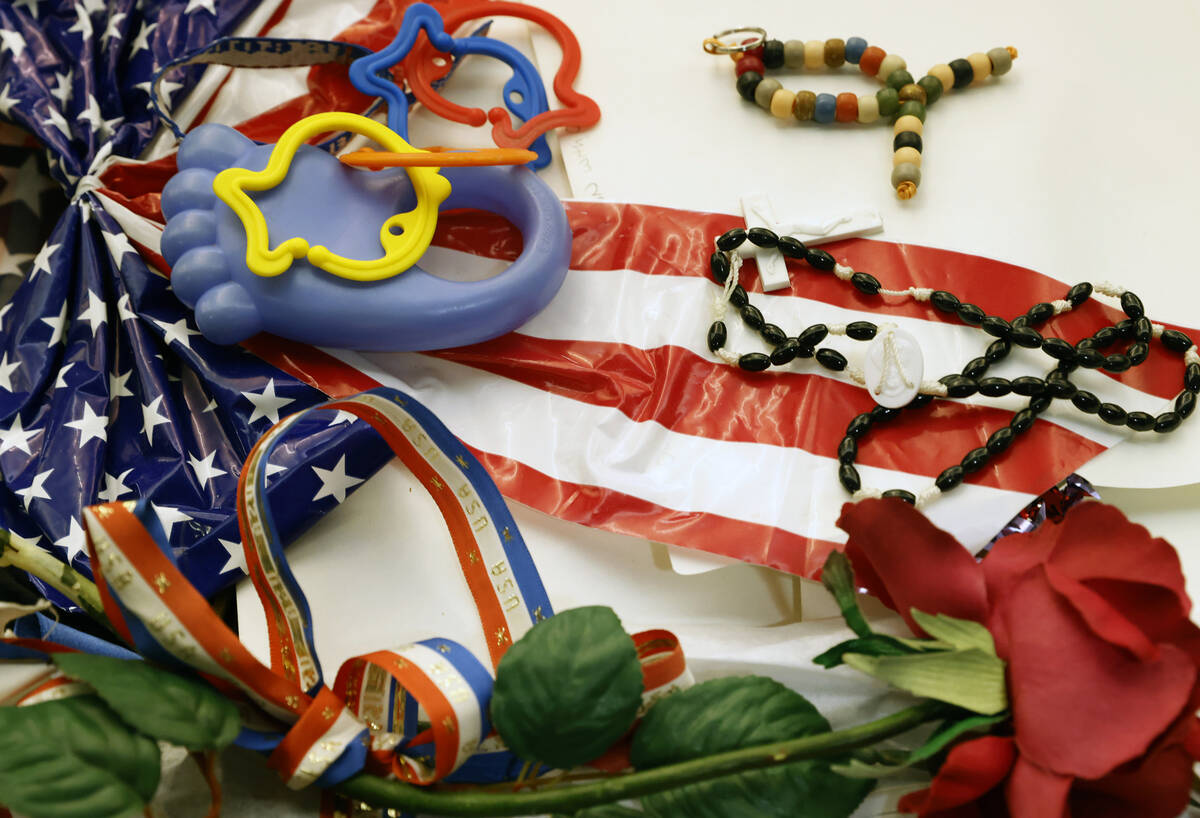
Twenty-five years after the Sept. 11 terrorist attacks, the effects of that day can still be seen across Southern Nevada.
The attacks were thousands of miles from Las Vegas, but the deaths of nearly 3,000 people touched the lives of Southern Nevadans and exposed the vulnerability of the tourism-dependent economy.
The attacks also permanently changed the way people travel, with new airport security requirements, a new federal agency and tighter security around some of the region’s most important infrastructure.
For Las Vegas, the changes began almost immediately.
Vulnerable Vegas
When 19 al-Qaida terrorists hijacked four commercial airliners on Sept. 11, 2001, federal authorities grounded all aircraft in the United States.
About 70 flights were canceled or grounded in Las Vegas that morning, leaving roughly 10,000 tourists stranded at local resorts for days because there were few ways for them to get home.
In the investigation that followed, authorities found that the hijackers self-trained in Southern Nevada before scheming their deadly plan.
FBI investigators reached no firm conclusions but offered two theories as to why the gang of hijackers spent time in Southern Nevada. One theory was that they were scouting potential terrorist targets around town; another was that with Southern Nevada’s welcoming disposition, they could plan and train with little fear of being discovered.
Another Southern Nevada tourism icon, Hoover Dam, was changed as federal authorities worried that it could be a potential terrorist target. Protecting the dam became a priority that sped development of the Mike O’Callaghan-Pat Tillman Memorial Bridge over the Colorado River, just south of the dam, because motorists were no longer allowed to drive over Hoover and truckers were forced to make a 23-mile detour through Laughlin as an alternative route between Las Vegas and Phoenix.
The immediate aftermath of the 9/11 tragedy quickly turned into an economic disaster for Las Vegas, but local residents still found it in themselves to mourn and make tributes.
With the Strip’s New York-New York and its iconic faux Statue of Liberty one of the few visual representations of that city easily accessible, residents and tourists turned the front of the property into a shrine commemorating those lost in the disaster. Flowers, New York souvenirs and T-shirts representing fire departments from around the country soon took up space in front of the Strip resort.
When tourism cratered nationwide in the wake of 9/11, Southern Nevada casinos laid off an estimated 15,000 workers. It would take years for the industry to recover, and when it did, there were 6,000 fewer jobs. Some resort properties with capital expenses in their budget plans postponed work.
Some Southern Nevadans were affected more personally and directly by 9/11.
Barbara Edwards
Barbara Edwards, a 58-year-old French and German teacher at Palo Verde High School in Las Vegas, was aboard American Airlines Flight 77 from Washington to Los Angeles that was crashed into the Pentagon.
She had been attending a wedding in Connecticut and was visiting friends in suburban Washington before heading home to Las Vegas. Edwards had been traveling with two friends, part-time Las Vegans Darlene “Dee” and Wilson “Bud” Flagg, a former Navy admiral, who split time living on a Virginia farm.
In 2003, a memorial was dedicated to Edwards at the southeast corner of Palo Verde’s soccer field — in the same spot where she enjoyed watching games. The memorial included the inscription “We will never forget” in English, French and German. The school also holds a ceremony in her honor every September.
Her son Doug Edwards told the Las Vegas Review-Journal in 2011 that his mom would be flattered: “I know for sure she’s very grateful that people haven’t forgotten about her.”
Others with ties to Las Vegas were connected to the 9/11 disaster.
Renee May
Former Las Vegas residents Ron and Nancy May told the Review-Journal in 2011 that their 39-year-old daughter, Renee, was a flight attendant on American Airlines Flight 77.
Renee May was one of two people known to have placed phone calls from the aircraft before it crashed.
She called her parents in Las Vegas at 6:12 a.m. local time to tell them her flight out of Washington’s Dulles International Airport had been hijacked. She told her mother to contact the airline and report what was happening. Then Renee May said, “I love you, Mom,” and the line went dead.
Accounts of that final call have been published in the 9/11 Commission Report and introduced at the trial of al-Qaida conspirator Zacarias Moussaoui.
Karen Wagner
Army Lt. Col. Karen Wagner, a 1982 graduate of the ROTC program at UNLV, was working at the Pentagon when the plane struck and was one of 125 who died inside the building.
Maj. John Thurman had been sitting two desks down from Wagner when the plane hit. With fire and smoke consuming the room, he tried to lead her to an exit as she crawled behind him, grasping his belt. Eventually he noticed that she had fallen silent and released her grip.
Wagner’s sister, Kim Wagner, who was working in Grand Prairie, Texas, when the disaster occurred and was interviewed by the Review-Journal in 2011, was called by a friend minutes after the news of the crash into the Pentagon occurred.
She and brother Warren and mother Mattie, who was living near San Antonio at the time, flew to Washington to attend three-times-daily briefings about the 125 people who perished there when Flight 77 crashed into the Pentagon’s west wall.
It wasn’t until Sept. 15 that casualty officers confirmed the dreaded news — Karen Wagner had died while trying to escape the inferno.
It wasn’t until just prior to the first-year anniversary in 2002 that Kim Wagner met with Thurman and learned the details of her sister’s last minutes of life and how she prayed as they crawled.
“That made me feel better,” Kim Wagner said in the interview, “knowing that she wasn’t by herself.”
Keith Schwer
UNLV economics professor Keith Schwer was attending a conference in the ground complex of the World Trade Center on the morning of Sept. 11.
Schwer, longtime director of the UNLV Center for Business and Economic Research who died in 2009, managed to escape the turmoil at Ground Zero that morning and made his way back to Las Vegas by car.
Schwer used research that came from his 9/11 experience to provide analysis on economic resilience, explaining how travel, tourism and hospitality can react and recover after disruptive events like 9/11 and the 2003 SARS outbreak.
9/11 remembrances
In addition to what has become an annual tradition to remember Barbara Edwards at Palo Verde, firemen and other first responders are dedicated to remembering with special observances in fire stations across Las Vegas on Sept. 11.
One memorial tradition in Las Vegas has occurred in recent years at The Strat, the tallest structure in Southern Nevada. After a brief honor guard ceremony with bagpipes there, first responders will scale 1,455 stairsteps to the top of the building as a tribute to those who lost their lives in New York.
Blake Sartini II, executive vice president and chief operating officer of Golden Entertainment, parent company of The Strat, said the significance of commemorating Sept. 11 has not diminished with time.
“I think every year the anniversary falls, I feel like that’s just a day that should always stand on its own, regardless of the years that have passed,” Sartini said.
The 9/11 tragedy has even found its way into arts and entertainment, and this year, Super Summer Theatre in Las Vegas has chosen to perform “Come from Away” as its last summer production of the season.
Performed under the stars at an outdoor stage at Spring Mountain State Park, the production is scheduled for several nights through Sept. 19.
“Come from Away” is a 2013 musical that recounts Sept. 11 in Gander, Newfoundland, where 38 planes were ordered to land at Gander International Airport and a tiny town unexpectedly hosted 7,000 passengers in the aftermath of the 9/11 tragedy.
Contact Richard N. Velotta at rvelotta@reviewjournal.com or 702-477-3893. Follow @RickVelotta on X.