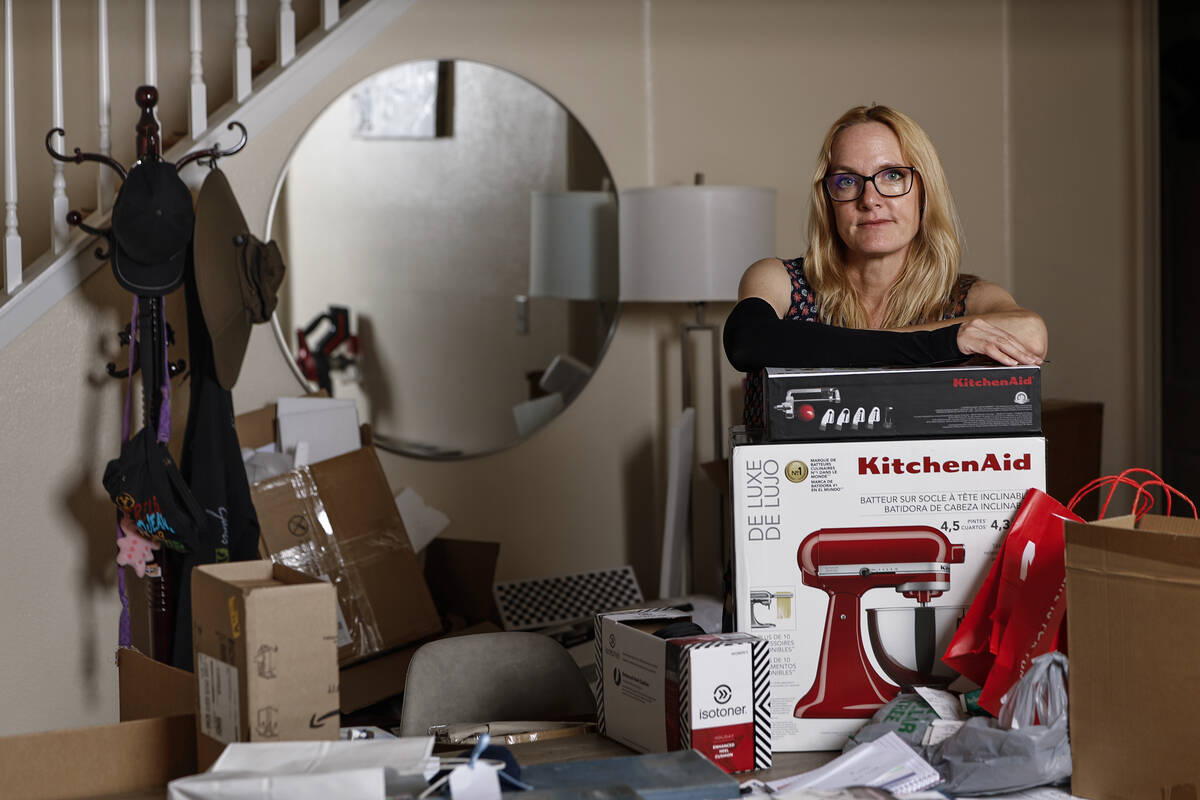
About a month ago, Gretchen Ashbeck, a local teacher, had her life turned upside down by a house fire.
It destroyed the home where she had lived for nearly 25 years and raised her two children, killed one of her two dogs, destroyed most of her belongings and left her with second- and third-degree burns.
Then, while at the lowest she has ever been, “everyone just kept slamming a door in our face,” Ashbeck said.
A GoFundMe has been created to support Ashbeck and her family.
“Because her ID, cards, and payment methods were lost in the blaze, even basic daily transactions are an immense challenge,” the GoFundMe’s description said. It was organized by Michelle Menard, a co-worker of Ashbeck’s.
Ashbeck and Menard are teachers at Walter Johnson Junior High School, which is part of the Clark County School District. Ashbeck is an art teacher.
Since the fire, Ashbeck has faced a series of challenges as she works to rebuild her family’s life.
‘This big flame just came out the front window’
On July 7, at 11:50 a.m., multiple callers reported a house fire in the 8000 block of Clear Blue Drive, near West Desert Inn and South Fort Apache roads in the southwest Las Vegas Valley, according to Jordan Moore, spokesperson for Las Vegas Fire & Rescue.
“The first responding unit arrived four minutes post-assignment,” Moore said. “Upon arrival, crews initiated an offensive strategy and subsequently upgraded the call to a 2-alarm fire to secure additional resources and personnel. The fire did spread from the residence’s casita and extended to the adjacent house without directly involving it. The secondary all-clear was given at 12:28 p.m.”
As Ashbeck recounts, after a long night of tending to one of her dogs’ stomach issues, she fell asleep on a couch in the first floor of the two-story residence between 10:30 a.m. and 11 a.m.
Her two kids, 18-year-old Liam and 17-year-old Lily, were upstairs in their bedrooms.
“I woke up to a siren and a flame in my kitchen,” Ashbeck said. “And then we ran out, and it took four minutes for the house to blow up.”
While sitting on a curb near her house, watching it go up in flames, Ashbeck was informed by her son that Mia, the family’s 12-year-old dog, did not make it out.
“I was going to run in and get her, and as I was about to run in, this big flame just came out the front window,” Ashbeck said. Hugo, the family’s other dog, who is still a puppy and was the one experiencing stomach problems earlier, did make it out.
According to Moore, Las Vegas Fire & Rescue has not yet determined the fire’s cause.
After the fire
“One resident was transported to (University Medical Center) with minor burn injuries and was subsequently released,” Moore said. “Unfortunately, one dog succumbed during the incident.”
Things went from bad to worse for Ashbeck once she left the hospital.
Bruised and recovering, she had little choice but to push through for her children, whose father lives in Florida. But with no home to return to and all forms of identifications lost in the fire, every step of rebuilding became another battle, from checking into a hotel to dealing with her bank and the Department of Motor Vehicles.
On the first night after the morning fire, Ashbeck and her children stayed at the home of her son’s friend.
The next day, on July 8, they checked into the La Quinta Inn & Suites by Wyndham Las Vegas Red Rock, a pet-friendly hotel.
However, what should have been a chance to regroup turned into another source of stress.
Although Ashbeck’s insurance had arranged and paid for the stay, she said the hotel initially would not let her check in without identification and a credit card in her name — documents that had been destroyed in the fire.
Once the family was settled, Ashbeck said that Hugo struggled to adjust to hotel life, barking whenever people walked past the room and drawing complaints from other guests. She also said the hotel, despite being pet-friendly, lacked a shaded area for dogs, making it difficult to take him outside during the Las Vegas summer.
“My dog was grieving,” Ashbeck said. “He’s just turned 12 months, and he lost his big sister who he’s had since he was eight weeks old. He lost his big backyard that he’s used to, his two-mile walk around the lake.”
The following day, on July 9, Ashbeck went to her Wells Fargo branch, hoping to withdraw money.
But without identification, bank employees would not allow her to access her account. Although she knew her personal identification number and her children had access to the bank’s mobile app — they took their phones with them when evacuating the home — Ashbeck said none of it was enough.
“The bank didn’t care,” Ashbeck said. “I have money, and they weren’t allowing me to get it because I did not have any kind of ID and I didn’t have my account number memorized. I knew my PIN. I could tell them when I opened my first bank account in 1985. Both my kids had their phones with the app and they still would not allow me to access any of my money until I got an ID. I was nine years old when I opened my savings account and (the bank) gave me a teddy bear named Cooper, and he’s still in my childhood home.”
Asked about the interaction, a Wells Fargo spokesperson said it “cannot discuss the details of an individual banking relationship but (it strives) to provide the best possible care and service in every interaction.”
By then, one thing had become clear: without a government-issued ID, Ashbeck could not move forward.
‘Why don’t you have humanity?’
So, on July 10, she headed to the Nevada Department of Motor Vehicles’ West Flamingo office for a new driver’s license, and had her worst experience yet, she said.
Ashbeck said an employee told her to complete the process online or return the following week, two options that were not viable.
She said it took her, her daughter and her former sister-in-law — who assisted the family in the days following the fire by driving them where they needed to go — to break down in tears before the employee asked the office’s manager whether any appointments had opened up. A cancellation that afternoon allowed Ashbeck to be seen.
But the ensuing interaction left her shaken.
Ashbeck, whose face was still healing from the burns she suffered, said another disgruntled employee questioned why her face was “oozing” before asking whether she wanted to retake her driver’s license photo or reuse the previous one.
“I was like, ‘Are you kidding me, woman?’” Ashbeck said. “And she acted like she was doing us this huge favor, and it’s like, no, why don’t you have humanity? I did not understand that at all.”
In response to Ashbeck’s account, the Nevada Department of Motor Vehicles apologized that her visit “did not meet the level of support and compassion she deserved.”
“We take customer service very seriously, especially in cases involving extenuating circumstances where individuals may require additional assistance and flexibility,” said Renato Lara, deputy administrator of the customer services division for the Nevada Department of Motor Vehicles. “Our staff are trained to follow established procedures designed to help customers who have lost identification documents or are unable to access online services. Based on the details shared, it appears these procedures were not followed consistently, and the level of empathy shown did not align with our expectations or our values.”
Lara said the Nevada Department of Motor Vehicles is “reviewing this incident internally.”
Meanwhile, Ashbeck said she has not received any support from the district.
“I’m a teacher for CCSD, they do nothing for us,” Ashbeck said. “And I’m like, ‘I’ve worked for you for 27 years, and there’s no support.’ That doesn’t make sense to me.”
A spokesperson for the district said it is “unable to expend taxpayer resources to support employees with housing situations,” but employees have access to the district’s Employee Assistance Program, “which offers help in managing stress, grief and loss, and other personal issues” at no cost.
Ashbeck said she had never heard of the program.
‘We’re trying to make the best of it’
Ashbeck eventually got her hands on a new driver’s license, allowing her to at least start the rebuilding process.
Currently, with Liam, Lily and Hugo, she is staying at a rental property covered by her insurance.
“We can’t be in a hotel with our dog,” Ashbeck said. “We took the very first (rental property) that we could find. It’s small, there’s no backyard, there’s no shade, you can’t walk anywhere. But it’s a house, and we’re happy. Well, we’re not happy. We’re trying to make the best of it.”
Contact Alex Streinger at astreinger@reviewjournal.com or 702-224-5505. Follow @AlexPStreinger on X.