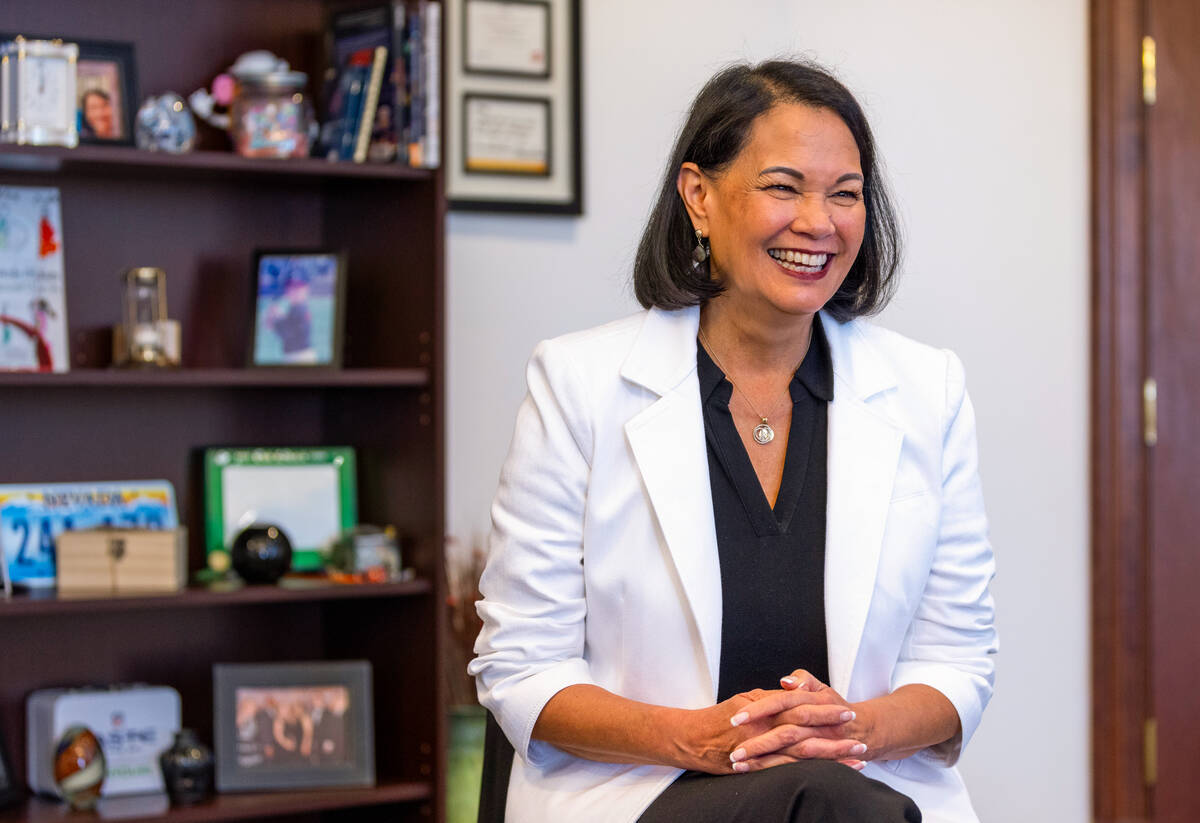
Clark County School District Superintendent Jhone Ebert has a simple message for valley drivers ahead of the school year’s start on Aug. 10: “Slow down.”
“Be aware of your surroundings,” she advised drivers and students on Monday after a school year where 427 student pedestrians were struck by vehicles, a 356 percent increase from the year prior.
Drivers this year will encounter a new law aimed in part at reducing school zone speeding. School zone traffic penalties as of July 1 have been doubled under a law passed and approved by Gov. Joe Lombardo in November. Ebert said she is excited to see the law take effect.
“We hope adult behavior changes,” Ebert said about the doubling of school zone fines.
For students riding e-bikes and e-scooters, which accounted for nearly half of all student collisions last school year, Ebert asked that they wear helmets and ride carefully.
Efforts to improve traffic safety have also come from various valley municipalities.
The city of Las Vegas announced the expansion of crossing guards at five high schools last week. Ebert said all elementary and middle schools will have crossing guards outside of them this school year.
The Clark County Commission heard 75 recommendations on how the county could curb pedestrian crashes from a report by the traffic safety working group last month, and the Clark County School Board will hear the same report on Wednesday.
On start times, ‘we’re following the research’
Students can expect to start their school days at a different time this year after Ebert announced changes to the bell schedule.
Generally, elementary schools will begin at 9:15 a.m., middle schools at 7:30 a.m. and high schools at 8:30 a.m. Compared to last year, elementary school will generally start 15 minutes later, middle school 30 minutes earlier and high school 1 hour and 30 minutes later.
Ebert reminded families to check their schools’ websites to find what their start times will be.
She acknowledged that students and parents will have to adjust to the new bell schedule, but reminded families that the start time changes are aimed at improving student success in the classroom.
“When high schoolers (were) starting at 7 a.m., people were critical of it starting at 7 a.m.,” Ebert said. “Now we have a shift. We’re following the research. We used the input from the community.”
‘Look beyond the diploma’
Academically, Ebert said the district this year is emphasizing career paths for students so “every child sees the ‘why’” behind attending class.
“Going to school isn’t just because your parents want you to, but it’s preparing you for your future,” Ebert said.
Ebert added that the district is working to ensure all students graduate with what she calls a “marketable asset.” This includes experience like AP or dual credit classes for college-bound teens, time in Junior ROTC for aspiring armed forces members and credentials for graduates en route to trade school.
“A gap that we’ve had in the past is, we just looked at getting the diploma. We need to look beyond the diploma. What is the next step?” Ebert said. She emphasized that the district wants to help students find their own post-graduation path, rather than have it selected for them.
Greater access for students to find their areas of interest is also a driving factor in the district’s effort to expand its open enrollment program, Ebert said. The district announced Wednesday it would offer up to $1,000 in transportation reimbursement this school year to certain open enrollment families, money that Ebert said comes from a $6.6 million state grant.
“There are many reasons within our community of why families would want to move, but we want to make sure that we support them in that choice,” Ebert said.
Contact Spencer Levering at slevering@reviewjournal.com or 702-383-0253.