While the nation’s leading measure of gun ownership continues to decline, Nevada is moving in the opposite direction, with its firearm background checks climbing to their highest first-half level since 2022.
Amid an ongoing, polarizing gun debate in America, the FBI’s National Instant Criminal Background Check System — the country’s primary mechanism for vetting weapon purchasing activity — processed 25.05 million firearm background checks last year.
That figure represented a 6.7 percent dip compared to 2024’s 26.8 million, continuing a pattern that has pushed the number of firearm background checks down 36 percent from a record-high 39.3 million in 2020. This marked the first time checks have decreased for five straight years since at least 2000.
“Lots of things affect firearm sales,” said Daniel Webster, professor at the Johns Hopkins School of Public Health. “Political environment, new restrictive gun laws being debated or signed into law can cause a pre-law spike, violence, confidence in police, violence carried out against people based on their race, ethnicity or gender identity.”
It is important to note that firearm background check totals do not equate to actual gun sales, as purchase records are not public information. Indeed, according to a 2017 study, “22 percent of gun owners who reported obtaining their most recent firearm within the previous two years reported doing so without a background check.”
Nevertheless, the data offers one of the clearest indicators of broader trends in gun buying.
From 2019 to the pandemic-stricken 2020, there was a 40.4 percent increase in firearm background checks, constituting, by far, the largest annual change in checks this century.
“Gun sales surged during the pandemic for several reasons,” said Timothy Lytton, professor at the Georgia State University College of Law. “One reason was fears about civil disorder due to the lack of responsiveness of emergency and police services, which led some first-time gun buyers to purchase weapons for self-protection.”
Lytton said that fears over government tyranny amid the implementation of restrictive public-health mandates also drove some longtime gun owners to buy more guns during the pandemic “as a way to affirm their commitment to the Second Amendment.”
However, by 2024, firearm background checks had already fallen to pre-pandemic levels. The swift decline had much to do with a steep falloff between 2021 and 2022, when background checks plunged from 38.5 million to 30.8 million, a 20.1 percent decrease.
Nevada’s firearm background checks
Since 2020, 48 of 50 states have seen drops in firearm background checks, with only Maryland and North Dakota deviating from the national trend. Moreover, the number of checks in 35 states declined last year compared to 2024.
Nevada was not one those 35 states.
In 2025, 143,098 firearm background checks were processed in the state, a slight increase over the 141,730 checks recorded in 2024 and the 141,728 in 2023.
Through the first six months of this year, 77,097 background checks have been conducted in Nevada, up 7.6 percent from 71,550 during the first half of last year. The state’s 2026 first-half firearm background check number is its most since 2022, when 80,710 checks were processed between January and June.
Meanwhile, the country is running counter.
In the first half of this year, 11.8 million firearm background checks were recorded in the U.S., down from 13.1 million during the same period in 2025, putting the nation on pace for a sixth consecutive annual decrease.
Temore Aziz, the owner of a Las Vegas gun shop, attributes the rise of firearm background checks in Nevada to an influx of new residents from states with stricter gun laws, particularly California.
According to Nevada Department of Motor Vehicle driver’s license surrender data obtained by the Las Vegas Review-Journal, more than 33,000 Californians moved to, or surrendered driver’s licenses in Nevada last year.
In the latest edition of “Freedom in the 50 States” — an index of personal and economic freedom — published in 2023 by the Cato Institute, Nevada was ranked the 29th-freest gun state, based on a measure of the “direct costs of gun laws to gun owners and dealers,” while California placed 44th.
On the ground
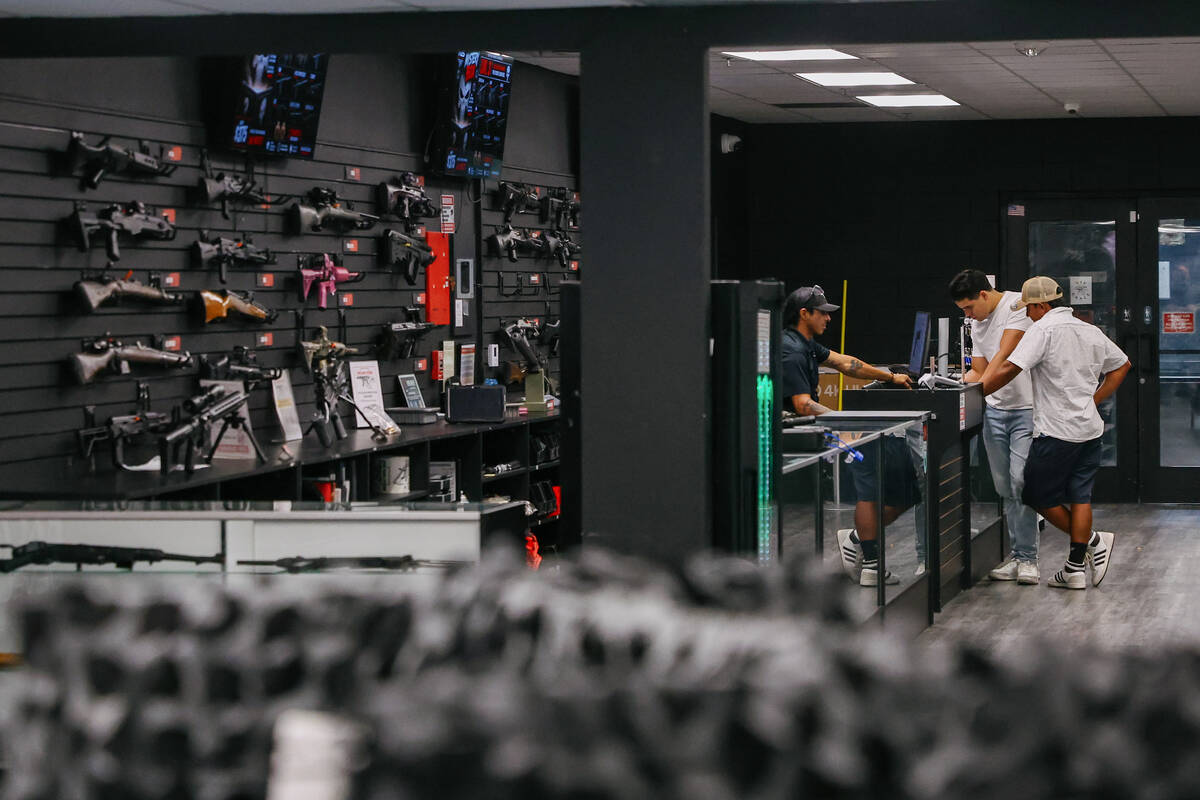
Aziz operates The Gun Store, a gun shop with an indoor shooting range, on East Tropicana Avenue between Harrison and McLeod drives in the east Las Vegas Valley, with his business partner, Shamel Hughes.
The pair — who are longtime collaborators, primarily in the entertainment business — took over the store, which has been around since 1988, in April.
They completely transformed its interior, while retaining its mission.
“We offer services that cater to the community, as well as to tourists that come in,” Hughes said. “When they come in, they don’t just get a firearm to go in there and shoot. There’s real instructions on safety, number one. We understand the hazards of the firearm business and industry. All of our range officers are trained to teach and elaborate gun safety.”
The business’ emphasis on safety and responsible ownership comes as it has seen an increase in gun sales, Aziz and Hughes said, reflected in the growing number of Form 4473s, a form prescribed by the Bureau of Alcohol, Tobacco, Firearm and Explosives to be completed when customers purchase weapons from licensed dealers.
Among the customers driving that growth, they said, two groups stand out: women and older adults. According to a 2017 Pew Research Center survey, middle-aged men are the most likely group in the U.S. to own firearms.
“(Buying a gun) is almost like a sugar pill,” Aziz said. “Instead of taking an antibiotic for your headache. It’s like a sense of peace.”
Contact Alex Streinger at astreinger@reviewjournal.com or 702-224-5505. Follow @AlexPStreinger on X.