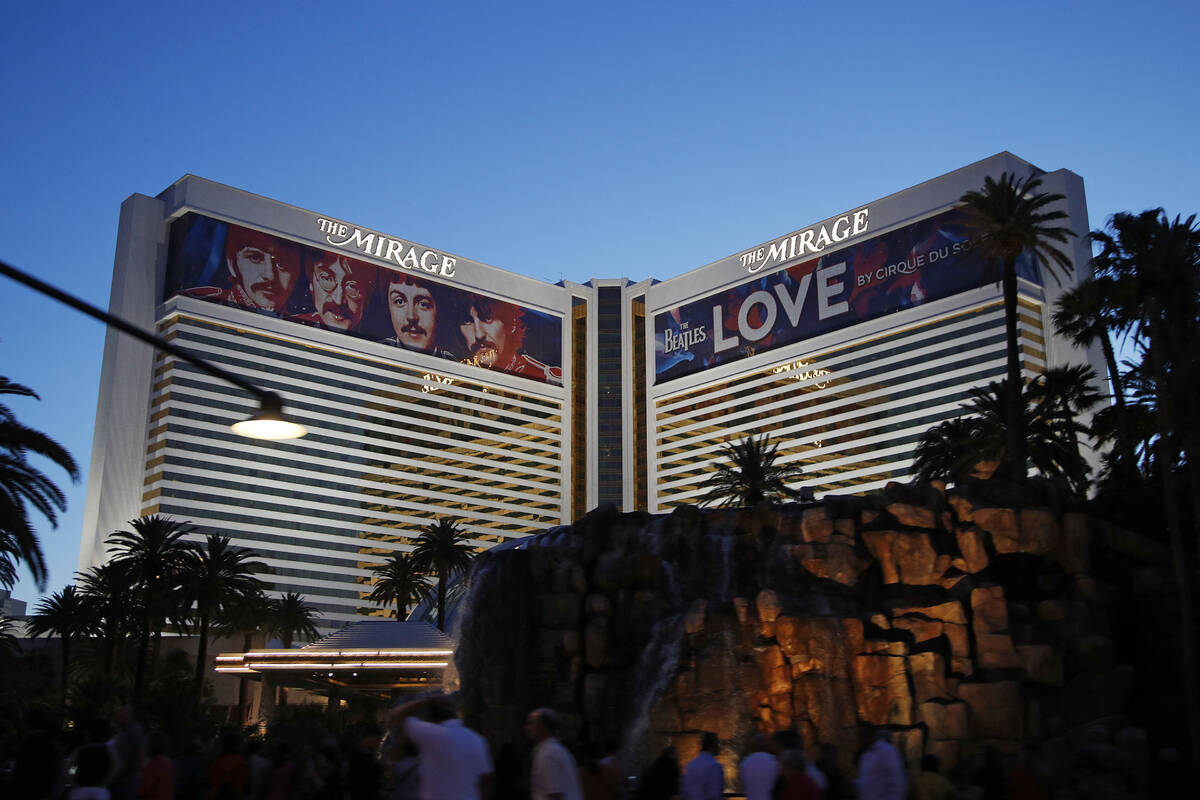
Former Wynn Resorts CEO Steve Wynn will discuss the integrated resort that forever changed Las Vegas — The Mirage — in a presentation to benefit the Neon Museum.
“Reflections of The Mirage: A Conversation with Steve Wynn” is scheduled for Oct. 22 at another resort significant to Wynn, downtown’s Golden Nugget, in which he purchased a controlling interest in 1971 before designing and building The Mirage, which opened in November 1989.
Tickets will sell for $79 and benefit the museum, which will launch this year’s four-day Duck Duck Shed architectural symposium the next day.
During the program, Wynn is expected to share firsthand perspectives on the ideas, challenges and decisions that shaped The Mirage and its role in the evolution of hospitality, entertainment and resort development. Through personal anecdotes, historical context and candid insight, the conversation will trace the origins of the storied property, from an audacious idea that challenged the prevailing economics and aesthetics of Las Vegas, to the unprecedented risks taken to finance, design and build a resort unlike anything the city had seen before.
Wynn will be interviewed onstage by Neon Museum Executive Director and CEO Aaron Berger.
“We are very honored that Mr. Wynn is going to participate in this dialogue and, by dialogue, this is really Mr. Wynn just recounting 1987 to 1992,” Berger said in a Monday telephone interview. “So it is focused solely on a very specific period and a very specific subject, which is The Mirage.”
Most expensive hotel
The Mirage, at the time the most expensive casino property ever built with a $550 million budget that eventually ballooned to $630 million, had 3,044 rooms and a 90,548-square-foot casino.
Wynn focused on designing spectacular attractions to draw people to the property with a faux volcano that erupted several times a night, a white tiger enclosure for the stars of a production show staged by illusionists Siegfried & Roy, a dolphin habitat and a Cirque du Soleil show, “Love,” featuring the music of the Beatles.
The Mirage was acquired in 2000 when Wynn’s company was bought out by what eventually became MGM Resorts International and closed July 17, 2024, after MGM sold it to Hard Rock International in 2022 for $1.075 billion.
Hard Rock International intends to rebrand the property as Hard Rock Las Vegas and is building a 42-story guitar-shaped hotel room tower on the site of the volcano due to open in 2027.
Steve Wynn built Wynn Las Vegas in 2005 and Encore Las Vegas in 2008 at the former site of the Strip’s Desert Inn. He resigned as chairman and CEO of the company in early 2018 after sexual misconduct allegations that he denied.
Berger has no doubt that it was The Mirage that defined what Las Vegas has become.
‘Created modern Las Vegas’
“Personally, I think it is the property that created modern Las Vegas,” he said.
“It was an integrated resort, a term many people around here didn’t know. It was taking this concept of entertainment, hospitality and leisure activities which many of the properties had, but added more. The Stardust had the Lido showroom and performances there and at the Riviera had certainly its offerings, but when The Mirage arrived, it again changed the way Las Vegas attracted visitors and what type of visitor was coming.
“The Mirage also provided a Disneyfication of the city. If you’re standing in line to check in at this luxury resort, you may have been truly mesmerized by that 90-foot-long fish tank right behind the front desk, and that’s an incredible way of allowing a visitor to not feel like they’re waiting in line, a Disney influence.”
Duck Duck Shed, which will begin the day after the Wynn presentation, is the Neon Museum’s primary fundraiser.
“Unlike other nonprofits, we don’t have a gala,” Berger explained. “We don’t do a series of roundtables and banquets and awards and things of that nature.
“We do Duck Duck Shed, and that is our fundraiser throughout the year. It’s a way of sort of flipping a gala on its head, and by doing Duck Duck Shed, we’re providing 40 programs, all educational, and each one benefits the museum.”
Contact Richard N. Velotta at rvelotta@reviewjournal.com or 702-477-3893. Follow @RickVelotta on X.