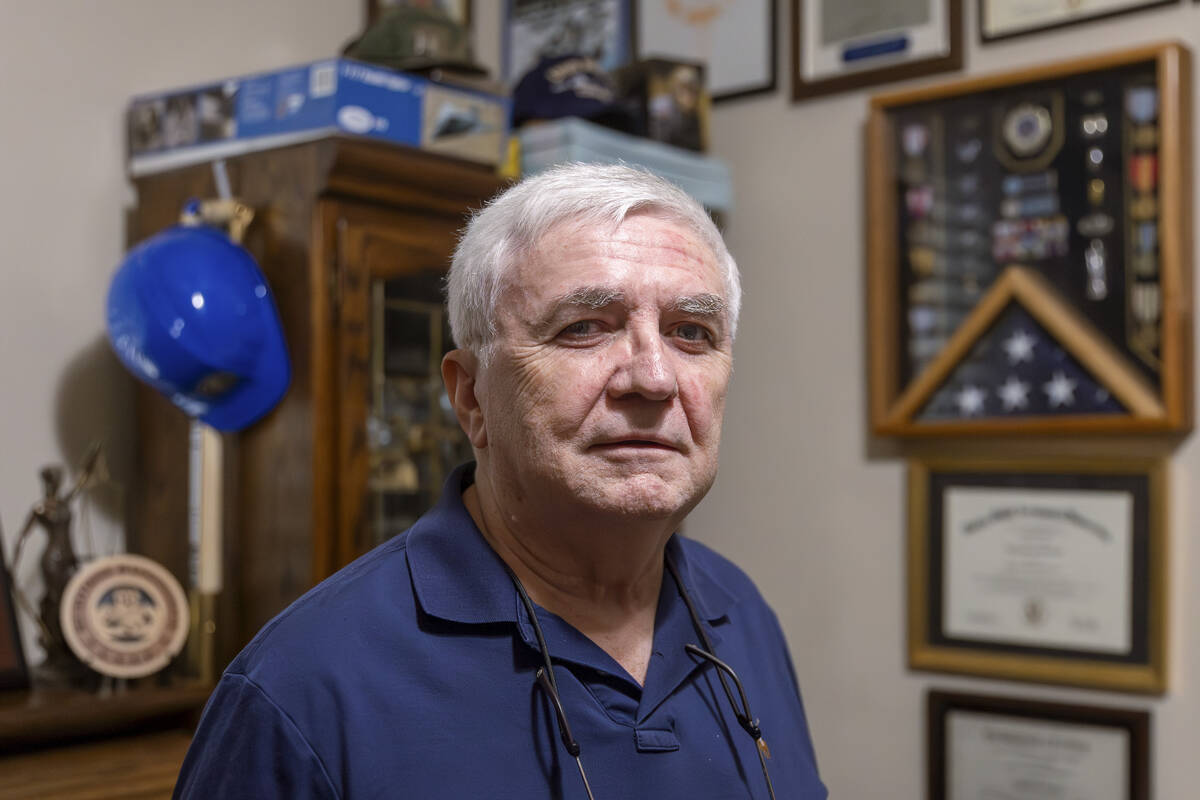
A longtime Henderson resident credited with starting the city’s police forensics crime lab is advocating for another important mission: increasing benefit opportunities for veterans who worked on nuclear weapons during the Cold War and got sick.
Rick Workman, 70, founded an advocacy group called The Sound of Silence Project in late 2021, and has been pushing for new laws to help those veterans ever since.
Before his two decades as a forensic crime scene analyst and manager in Henderson, Workman served for nearly two decades as a nuclear weapons technician in the U.S. Air Force.
During the Cold War, he and tens of thousands of other technicians maintained the nation’s nuclear weapons stockpile with inadequate protection from radiation and other toxic chemicals.
“What we did not know is those weapons always emitted neutron and gamma radiation 24/7 continuously,” Workman said. “So we were always radiated at all times.”
Workman believes federal law needs to be passed so that if Cold War era nuclear weapons technicians get sick from cancer or other illnesses caused by radiation, it is automatically presumed by law that the illness was caused by their work for the military.
“If you were there, did this work and you have certain diseases, you have an automatic presumption for both exposure and causation when the law is passed,” Workman said.
Workman already has a distinguished career in the Las Vegas Valley as a crime scene analyst. After his military service, he worked for the Metropolitan Police Department’s crime scene lab as a civilian employee for five years and was a lead analyst on some major crime cases. He was a lead forensic analyst on the case of Zane Floyd, who killed four people at a Las Vegas Albertsons supermarket in 1999.
Floyd was convicted and is awaiting execution on Nevada’s death row.
Workman went to work for the Henderson Police Department in April of 2000. The department at the time relied heavily on forensic crime scene analysts from Metro to process crime scenes.
Workman led the way in creating job descriptions and establishing scientific standards for the department’s now internationally accredited forensic laboratory, where Workman served as the criminalistics administrator and forensic laboratory director.
He also ran unsuccessfully for mayor twice in Henderson.
His time is now spent advocating for Cold War veterans who worked to maintain the nation’s nuclear stockpile.
Workman joined the Air Force in 1973 when he was 17 and started off as a nuclear weapons technician in Korea. Over time he maintained, inspected and then supervised work to maintain nuclear weapons at military facilities across the world.
During much of his nearly 20 years in the military he and other weapons technicians worked on the devices without a dosimeter, which measures exposure to radiation, and without radiation protection. When he first started, most technicians worked on weapons using their bare hands.
“I would get in there, have my head inside there, and we would take the bulkhead off, and there was only one little piece of metal separating the pit from our face, our head,” Workman said.
He said weapons technicians were also exposed to a litany of toxic chemicals used to clean the devices.
“We did what we were told,” Workman said. “I won’t say we were in a hurry but there was no concern, no consideration, no thought on our part even that we needed to be safer in what we were doing.”
“There wasn’t a whole lot of criteria for safety,” Workman added.
He stayed in touch with a lot of his fellow veterans over the years and learned that many people who worked on the nuclear weapons during the Cold War became sick, and many died from diseases like cancer and leukemia. He has since spent an extensive amount of time researching the topic and is convinced the work caused many of his fellow veterans to get sick.
He started The Sound of Silence Project simply to enhance communications amongst veterans, online and via social media, to increase knowledge and communications about the hazards the weapons technicians were exposed to. He said to this day a lot of veterans who worked in the field don’t talk about the issue in part because much of the work they did at the time was classified.
Working to pass new law for exposed veterans
He has also advocated through The Sound of Silence for changes to U.S. Code pertaining to veterans benefits. He wants a law to be passed, or a bill to amend current federal law, so nuclear weapons technicians of the era who got sick from certain diseases are automatically recognized as “radiation-exposed veterans” and that they engaged in a “radiation-risk activity.” Doing so would make it much easier for Cold War veterans who got sick to qualify for benefits.
In 2024, Workman worked with the office of Catherine Cortez Masto, D-Nev., to draft the Cold War Veteran Nuclear Weapons Technician Act but it has not been passed into law. Workman said Reps. Dina Titus, D-Nev., Jack Bergman, R-Mich., and Mark Takano, D-Calif., have been supportive.
“Nevada’s service members dedicate their lives to this country, and when they reenter civilian life, they deserve high-quality health care that meets their needs,” Cortez Masto said in an email, adding she will “continue working with Nevada veterans and advocates to find solutions to ensure those exposed to radiation while serving our country receive the care, benefits, and support they have earned.”
The U.S. Department of Veterans Affairs said if a veteran has a health condition caused by contact with radiation during service, they may be eligible for disability compensation.
“When there is no presumptive for a given condition, VA evaluates claims on a case-by-case basis to establish a military service connection,” department press secretary Quinn Slaven wrote in an email. “VA considers all evidence such as private medical records, service treatment records, service personnel records, statements from the Veteran and buddy statements. VA may also request a medical examination at no cost to the Veteran.”
Workman believes more must be done. If you would like more information on the The Sound of Silence Project, you can find their website online or reach Workman at 702-763-8232.
“We were radiated and not told,” he said. “In fact when anyone dared to question it, they were told, ‘Don’t worry about it. It’s safe.’”
Contact Glenn Puit at gpuit@reviewjournal.com.