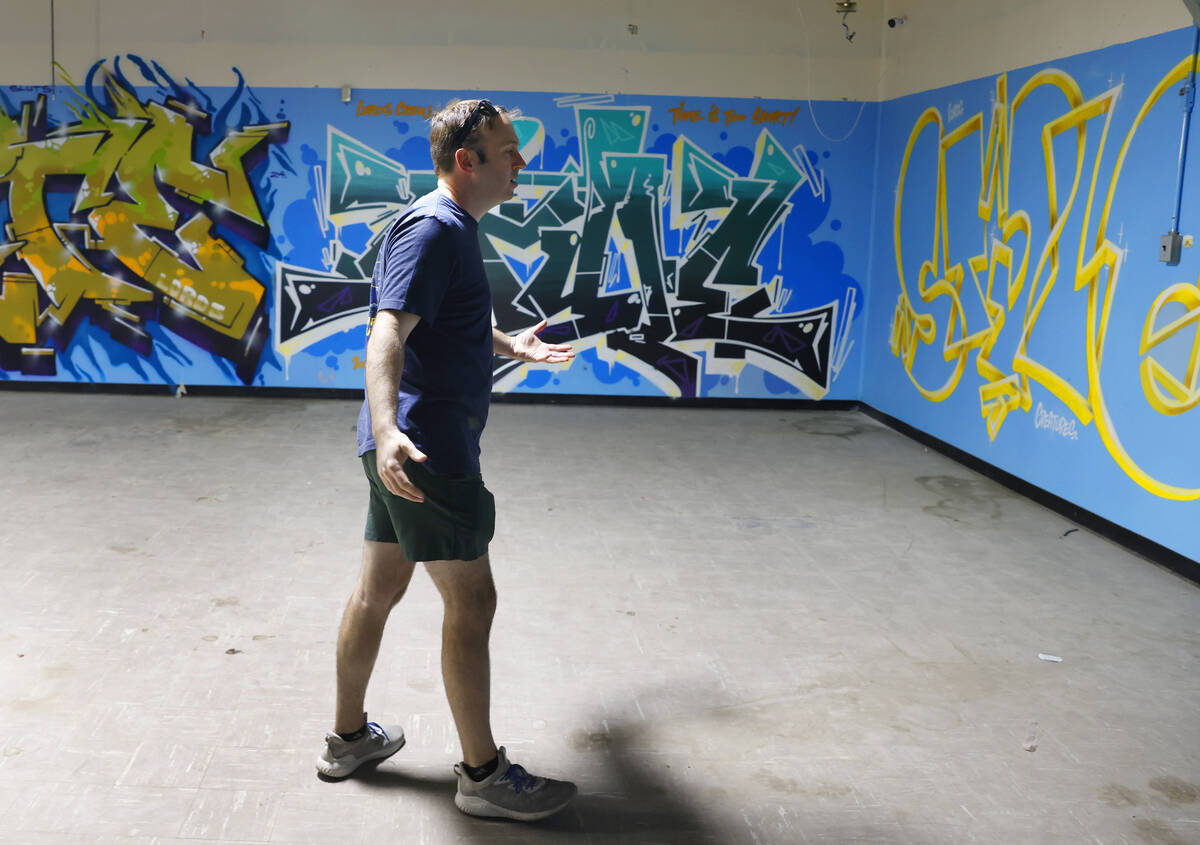
BAKER, Calif. – The walls are covered in graffiti, some glass is shattered, and most of the copper is gone.
But some 20 to 30 feet below ground in this Cold War-era bunker in the middle of the California desert, Jonathan Shinn envisions a modern twist for the hidden relic: a lounge for EV drivers.
Shinn, founder of PowerStation Charging, purchased this remote site along Interstate 15, roughly 100 miles southwest of Las Vegas, a few years ago. He’s already installed an electric-vehicle charging station, and a field of solar panels to power it, and he wants to turn the underground bunker into a spot where drivers can kick back while their cars juice up.
He doesn’t yet know how long it would take, or how much it would cost, to transform the subterranean space. But he figures the novelty alone would draw plenty of drivers along the heavily traveled route between Las Vegas and Southern California.
He plans to keep much of the graffiti intact, viewing it more as artwork than vandalism, and wants to keep the industrial-bunker feel of the place.
“People will actually want to come and see this,” he said.
Decontamination shower
Shinn, a 39-year-old San Diego-area resident, has set out to open four solar-powered EV charging stations in Southern California. Closer to Las Vegas, his property is just off the Rasor Road exit on I-15, about 13 miles southwest of the main commercial drag through the pint-sized town of Baker.
The 10-acre plot in San Bernardino County has more than 1,000 solar panels in place and a charging station that can feed power to four cars at a time.
The property also has a small above-ground building that looks like some kind of storage shed, with no visible clue as to what’s below.
According to Shinn, the underground bunker spans more than 8,000 square feet and was built in the 1960s. It was a communications facility — and, he said, was designed to survive a nuclear blast 15 miles away or some other aerial bombardment.
The bunker was heavily vandalized over the years. But it still has remnants of the old days, including a decontamination shower, motors, shredded lines of copper, control-pressure gauges, a heavy vault-like main entry door, and an inspection stamp, dated 1963, from I-T-E Circuit Breaker Co.
‘It was heartbreaking to see it get vandalized’
AT&T previously owned the site, though property records obtained by the Las Vegas Review-Journal don’t show when it acquired the plot. The telecommunications giant did not respond to a request for comment.
Ultimately, AT&T sold the site in 2006 to investor Gil Stoffels of Portland, Oregon, according to property records and business-entity filings.
Stoffels sold the property in 2016 but reacquired it through foreclosure in 2018, property records show.
Then, in 2024, he sold the site to Shinn.
Stoffels told the Review-Journal this month that the U.S. Army Corps of Engineers built the bunker. He also said that it was a “good conversation piece” to tell people he owned the sprawling underground facility.
He even charged a $1,000 “showing fee” to serious would-be buyers. Stoffels said that for him to give a tour, he had to fly down, rent a car, stay in a hotel, plus “gamble a little bit.”
Stoffels recalled that when he bought the property, he had no particular plans for it.
“In hindsight, I should have made it a museum because it was fully functional,” he said. “It was heartbreaking to see it get vandalized.”
‘Pretty much all the copper’
Stoffels said the bunker was vandalized a few times while he owned it. He once encountered a few people at the property, including someone who was inside.
Baron Castillo, who brokered the sale to Shinn, said there was paperwork all over the place when he visited the bunker.
He also said that there was a lot of graffiti — and that people sprayed even more after he listed the property for sale.
Castillo, owner of real estate firm Apartment Building Investments, has listed burned-down gas stations and other unusual properties. Still, the bunker stands out.
“This is up there,” he said.
Shinn said he added a secured entrance to the building above the bunker after he bought the site, but before that, anyone could walk in. As he described it, he sent a crew that hauled out a Dumpster-sized volume of trash.
The vandalism was extensive. The bunker was smothered in graffiti, equipment was busted, and, according to Shinn, vandals took “pretty much all the copper,” even using a torch to get some out.
‘A side of modern graffiti’
Shinn bought the site for $450,000. He has since installed security cameras inside and out and wired the bunker to have some lighting.
He also plans to install another 500 solar panels outside and six more EV charging ports.
He put the total cost of the build-out at $4 million to $5 million but said this would drop to the $3 million-range after accounting for federal tax credits.
Shinn said that he opened PowerStation Rasor Road in the first quarter of this year and that it’s logged more than 1,000 charges.
So far, drivers have been able to charge up for free. Shinn said that he wanted to make sure the systems are running smoothly, but he noted the pricing kicks in next month.
As for the lounge, he plans to offer prepackaged snacks and drinks and possibly charge a flat entry fee. He also said it would have cameras and a secured entrance.
He figures he would send workers to clean the restrooms and restock the food, but otherwise, it won’t be staffed 24 hours a day.
But above all, he wants the bunker to still feel like one.
Shinn said that he’s trying to restore the paint colors and that he plans to keep the graffiti he attributes to a group known as the Lords Crew.
Overall, he wants an “industrial-bunker themed” environment down below — “with a side of modern graffiti.”
Contact Eli Segall at esegall@reviewjournal.com or 702-383-0342.