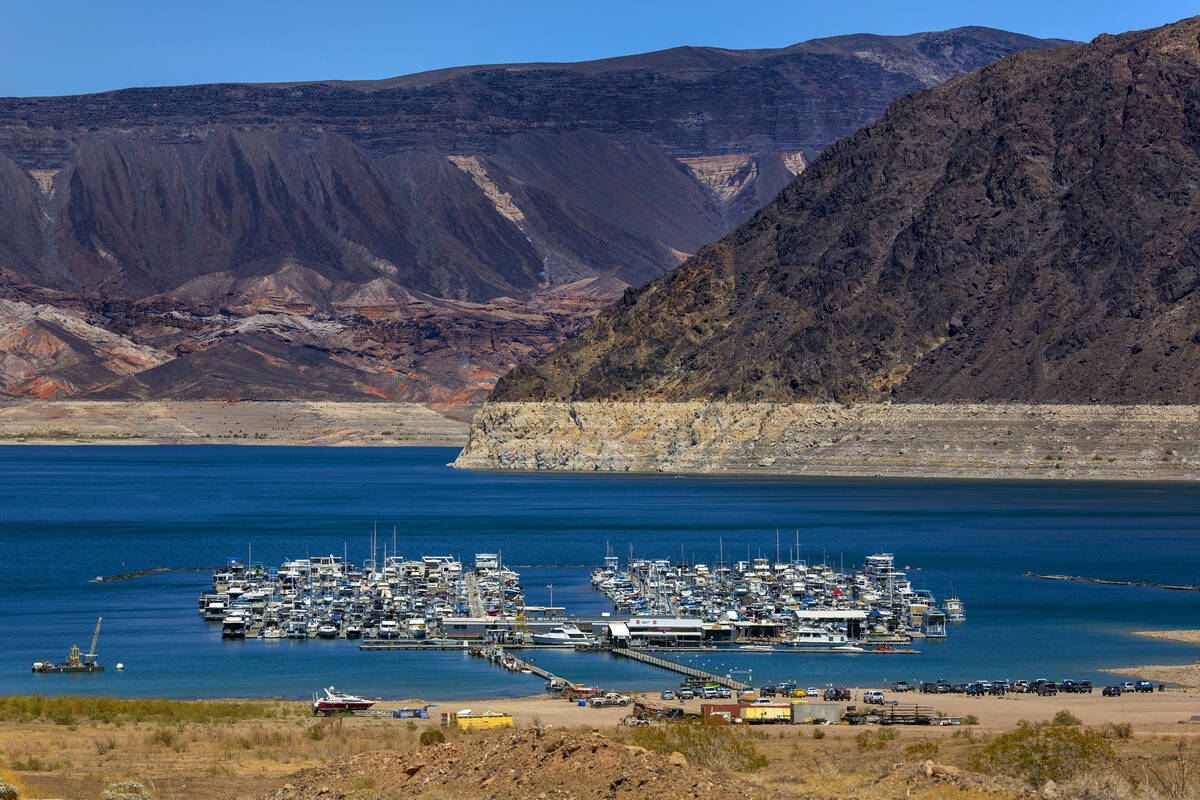
It’s a race to the bottom for Southern Nevada’s primary water source as federal forecasters again downgraded how low they expect Lake Mead to go over the next two years.
By the end of next month, the Bureau of Reclamation expects Lake Mead to drop below its record low of 1,040.58 feet above sea level set in 2022, according to projections released Wednesday. And though studies are less reliable the further out they are, projections predict that the reservoir will continue its slow march downward to about 31 feet below that historic low in June 2028, to 1,009.69 feet above sea level.
The most recent data from June shows the lake level at 1,044.58 feet above sea level.
“We’re blowing through our reserve supplies and storage,” Jennifer Pitt, Colorado River program director at the Audubon Society, said in an interview Wednesday. “Once that bottoms out, we don’t have a choice but to start figuring out how to reduce uses of water across the watershed.”
Wednesday’s update is a slight downgrade from last month’s projection but is still reflective of this water year’s abysmal snowfall and the Trump administration’s emergency move to reduce flows into Lake Mead to protect Lake Powell’s infrastructure.
It comes days before the Bureau of Reclamation is expected to release a final environmental impact statement in the absence of a seven-state consensus between officials in the Colorado River Basin. The federal government’s intervention, experts have argued, could spur a costly legal battle at the U.S. Supreme Court.
“It speaks to the urgency of getting new Colorado River management rules in place that are up to the task of managing this kind of dry situation,” Pitt said.
And it’s a very dry situation. A leading group of researchers released a short paper on Tuesday that asserted the combined storage of Lake Mead and Lake Powell hasn’t been this low since 1957, during the construction of Glen Canyon Dam.
“Every day going forward, until runoff from the 2026-2027 winter snowpack begins next spring, a new record low will likely be set,” the authors wrote. “This is a significant moment in the evolving Colorado River water supply crisis.”
One critical elevation that water managers are looking out for at Lake Mead is 1,035 feet above sea level.
Under that level, only five of Hoover Dam’s 17 turbines can generate power, according to officials. Lake Mead won’t dip below that elevation until April 2027, the projection shows.
The Southern Nevada picture
Southern Nevada’s access to Lake Mead is protected by one of the region’s past investments.
Below a lake level of 895 feet, only Southern Nevada can withdraw water, cutting off California and Arizona entirely in what’s known as a “dead pool.” That’s thanks to the Southern Nevada Water Authority’s third intake and low-level pumping station that provides Nevada with the exclusive ability to draw water at 875 feet.
“I could not fathom that anybody responsible would ever let the lake get to dead pool,” Pitt said. “But if it did get there, it would not be dead pool for Southern Nevada Water Authority.”
Bronson Mack, a spokesman for the water authority, said in a statement that the region remains well-prepared as Lake Mead levels decline. The agency does long-term resource planning under many different scenarios, accounting for poor conditions and population growth.
It recently signed a memorandum of understanding with California to explore a water transfer that would allow Southern Nevada to benefit from the Carlsbad Desalination Plant in San Diego.
“Decades of conservation, extensive water recycling, stored water supplies and investments in our deep-water intake and Low Lake Level Pumping Station help provide water supply reliability for our community,” Mack said. “At the same time, continued conservation remains essential, as we all play an important role in using water efficiently.”
Contact Alan Halaly at ahalaly@reviewjournal.com. Follow @AlanHalaly on X.