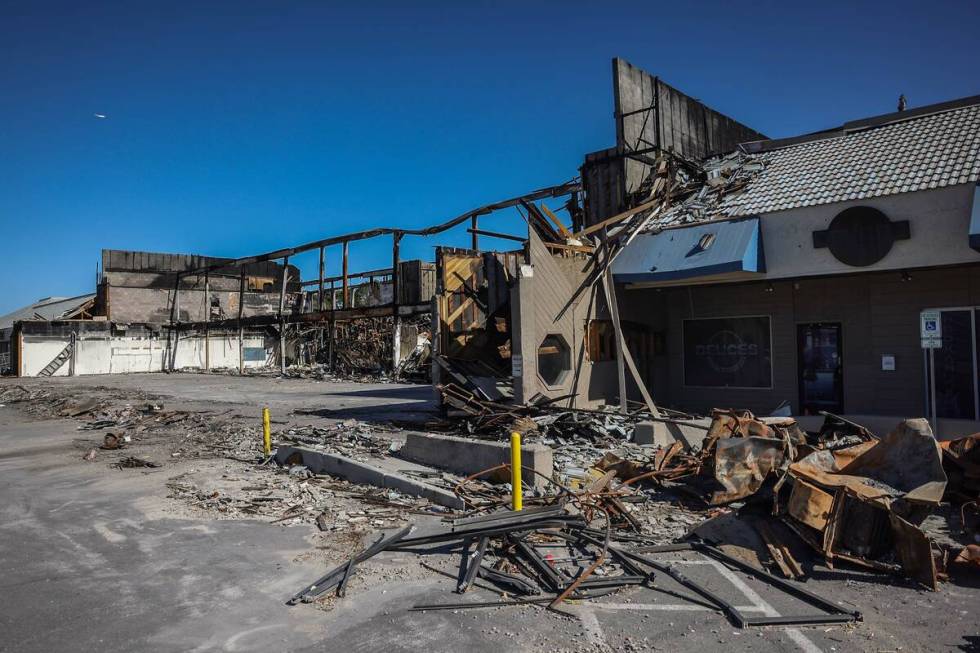
After a fire ripped through a commercial complex near UNLV last summer, the fire-damaged section and adjacent shops were torn down in recent months.
Work crews have demolished the two-story section of University Gardens that was destroyed in a fire in July 2025. They also leveled adjacent stores that were boarded up following the blaze.
All of the now-demolished buildings — including the remaining steel skeleton of the structure that caught fire — were still standing as of February. At that time, the site was also still littered with mounds of twisted metal and other debris from the blaze that caused millions of dollars in damage and left small-business owners devastated.

Clark County records show the buildings were torn down by mid-May, leaving a dirt lot that’s there today. The leftover debris has also been cleared from the site.
The buildings had been home to eateries, a U.S. Post Office and other businesses. For now, at least, it’s unclear what will happen to this now-flattened section of the shopping center on Maryland Parkway between Tropicana and Harmon avenues, across from UNLV’s campus.
Clark County Building Department records do not show any new project plans for the site, and landlord Steven Gryczman did not respond to requests for comment.

‘We’ve lost everything’
Around 8:10 a.m. on July 25, 2025, the two-story portion of University Gardens went up in flames. The fire, which did not cause any deaths or injuries, gutted the building at 4632 S. Maryland Parkway.
It caused an estimated $6 million in damages, and while investigators concluded the fire was accidental, they could not determine how it started, according to a report from the Clark County Fire Department’s investigation division.

As described in the report, a deformed steel beam in the building indicated that temperatures reached 1,000 degrees and higher in that area.
Crown Electric Tattoo, one of the tenants, said on Instagram on the day of the fire that it was “absolutely devastated.”
“We’ve lost everything. All of us. Everything,” the post said.

Taste Budz Creole Kitchen, another tenant, later posted on Instagram that its “business and employees have been devastated by the destruction of this fire” and that it lost everything.
The structure did not contain fire sprinklers because of its age, the Las Vegas Review-Journal previously reported.
Clark County property records list the construction year as 1980.
‘Damaged skeleton’
In a letter typed up the same day as the inferno, Clark County Building Department Director James Gerren told the fire department that the bulk of the damage appeared limited to the central two-story structure.
The one-story sections flanking that portion to the north and south did not appear to be “directly impacted by the fire,” he wrote.
But, he added, there was concern that if the “damaged skeleton” of the two-story section shifts, the adjacent structures could be damaged.

All told, the building department recommended that the property owner “be required to take immediate action to demolish the fire-damaged skeletal remnants” and to “stabilize the remaining portions of the building,” Gerren wrote.
On Aug. 12, a few weeks after the fire, the building department issued a demolition permit, valued at $81,000, for the burned section, records show.
The fire-damaged structure, however, remained standing for several more months. Also, the adjacent commercial space on each side was closed, with several storefronts covered in plywood.
‘Originally unforeseen circumstances’
The building department declared the fire-damaged section to be unsafe and prohibited any occupancy of the building, but it did not require the owner to demolish the structure, county spokeswoman Stephanie Wheatley told the Review-Journal in February.
The owner had most of the debris removed and secured the site with chain-link fencing, she added.

Wheatley said the department had been in regular communication with the owner and chose not to issue a formal notice and order for abatement because the landlord voluntarily applied for, and obtained, a demolition permit.
She also said that the department granted a time extension on the permit in February and had conducted several site visits since the fire, to confirm it was secured and unoccupied.

Gryczman, the landlord, wrote a letter dated April 10 to the building department, saying he now needed to also demolish the north and south wings of the fire-damaged two-story structure.
He cited “originally unforeseen circumstances” as the reason, without elaborating.
Contact Eli Segall at esegall@reviewjournal.com or 702-383-0342.