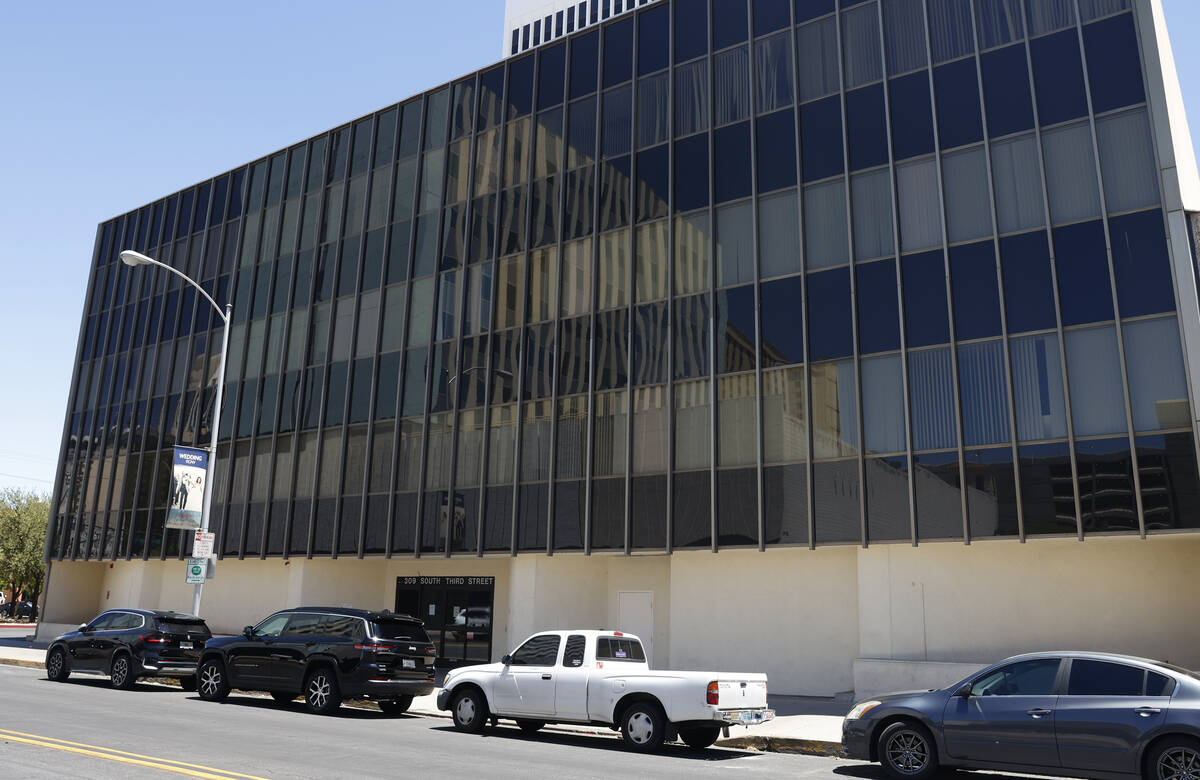
Years before an attorney alleged that the public defenders’ building in downtown Las Vegas was contaminated with a toxic chemical, a lawsuit made similar claims about a separate county building.
Much has changed for Clark County public defenders in the weeks since attorney Ryan Gormley’s May 15 letter to the county asserted that their longtime office at 309 S. Third Street was contaminated with polychlorinated biphenyls, chemicals commonly known as PCBs.
By July 3, public defenders’ office staff and staff from the county law library, which was also housed in the building, had been “evacuated,” Clark County Defenders Union President David Westbrook said previously.
For the past week, public defenders have been navigating shared office space in another county building, trying to communicate with clients and remain effective attorneys without the structure their old building provided. The county has told them that it is unknown when they will be able to return.
Gormley’s letter hinted at a future lawsuit, telling the county to preserve evidence.
“We represent several individuals who currently work, or previously worked, in the Building and who have suffered significant illnesses, including but not limited to cancer — conditions that scientific literature has causally linked to PCB exposure,” the letter said, according to a copy obtained by the Las Vegas Review-Journal. “While we continue to evaluate the full scope of the medical and scientific evidence, we anticipate asserting claims arising from and related to PCB contamination in the Building.”
Clark County spokesperson Stephanie Wheatley declined a request for interviews with county officials involved in the evacuation of the public defender’s building.
Meanwhile, the prior lawsuit filed in 2021 continues over alleged contamination at the Clark County Government Center, located less than a mile from the public defenders’ office.
Lawsuit over County Government Center
The 2021 suit, which named Clark County, Union Pacific Railroad, the Monsanto Company, the city of Las Vegas’ redevelopment agency and other companies as defendants, was filed on behalf of a slew of living and dead people who had worked at or visited the Clark County Government Center.
Plaintiffs’ attorneys Craig Mueller and Lindsay Dibler alleged that their clients had suffered “substantial exposure” to polychlorinated biphenyls and other chemicals.
The PCB exposure caused health problems including breast cancer, brain cancer, autoimmune disease and Parkinson’s Disease, they asserted. They said some people died.
The suit said that the government center was built on top of a contaminated railroad dump site but that the county did not disclose its toxicity to employees
The suit said city and county knew that the railroad had “dumped raw diesel fuel, Bunker C fuel, lubricants, solvents, jet fuel, ethanol, heavy metals, and liquids from electrical transformers and capacitors into an open trench, later burned that waste fuel in the trench, and then moved that burned waste into a disposal pit that sat right in the middle of where the Clark County Government was to be constructed.”
Officials “knew of hydrocarbon contamination, but also PCB, benzene, dioxin, furan, and lead contamination of the site, and also knew that construction excavation for the Clark County Government Center building would exceed 2.5 feet in depth,” the suit said.
Yet the railroad planned to only remediate 2.5 feet of soil that contained visible staining, according to the filing.
Soon after the building opened in 1995, the attorneys alleged that problems became apparent.
“Workers whose main jobs had them working in the basement of the building were getting sick, and workstations daily would have a black dust/soot that covered that covered their desks and would cling to the sides of their cubicles,” the suit said.
One Clark County employee became so concerned that he collected soot from his desk, saving it in an envelope, according to court papers.
The plaintiffs’ attorneys said testing “linked outside ground contamination of PCBs to indoor contamination of the same PCBs.”
District Judge Kathleen Delaney dismissed the case against the county in 2021, signing off on a submitted order stating, in part, that the plaintiffs had not shown the county intended to cause them harm. The case has been moved to federal court, where it continues against other defendants.
A Union Pacific spokesperson declined to comment on the suit’s allegations. A city spokesperson also declined to comment.
Attorneys for the railroad have argued in court papers that the company remediated the site in accordance with state and federal guidelines. The redevelopment agency has argued that the plaintiffs did not allege that the city dealt directly with them and did not articulate what the agency’s responsibility was to them as a former landowner.
“The Company will vigorously defend itself against these meritless claims and is confident that the evidence will show that Monsanto is not responsible for the alleged injuries,” a Monsanto spokesperson said in a statement. “Monsanto never manufactured, used, or disposed of PCBs in Nevada, and never owned or controlled the site at issue in the litigation.”
Public defenders adapt
“It’s been impressive to watch our office kind of rally and figure out solutions on the fly,” said Deputy Public Defender Olivia Miller, one of the attorneys who had to leave 309 S. Third St.
The closure of the main public defenders’ building has still posed logistical problems. The office has consolidated from multiple floors in two buildings, to two floors in another county office building, she said.
“Even just waiting for the printer is a longer experience than it was last week,” said Miller.
Her team — seven attorneys and support staff — has consolidated into a shared office in the Phoenix Building, with attorneys working remotely part of the time, making collaboration more difficult, she said.
In 309 S. Third St., attorneys’ desk phones had secure lines to call clients in the Clark County Detention Center, according to public defenders. Those calls would not be recorded, allowing public defenders to speak freely with their clients.
The Phoenix Building has shared phones that allowed public defenders to make the same kind of calls, but in the immediate aftermath of the evacuation, they could not call jail clients confidentially while working from home, though they could conduct video visits, public defenders said.
By the end of the week, Miller said that public defenders were told they would receive virtual access to their desk phones to contact jail clients with a confidential line.
“The last week has been a bit of a mess,” Deputy Public Defender Brennan Bartley said. “It’s been very impressive seeing the ways that my co-workers are stepping up, but it is also, I think, very much a temporary solution to obviously a very serious long-term problem.”
He expressed ambivalence about the move.
He was not upset to leave a building that “may be causing cancer harms,” he said, but was also frustrated at “not having somewhere to go.”
“The move out of the 309 building was absolutely necessary for the safety of all public defender employees, but the current office space is just not adequate for our needs,” Westbrook, also a public defender, said Friday.
He said he hoped the county would work with public defenders to find appropriate office space.
“It’s just a lot of uncertainty,” Miller said. “And I think the uncertainty coupled with having to iron out all of these kinks live is rough for a lot of people.”
Contact Noble Brigham at nbrigham@reviewjournal.com.