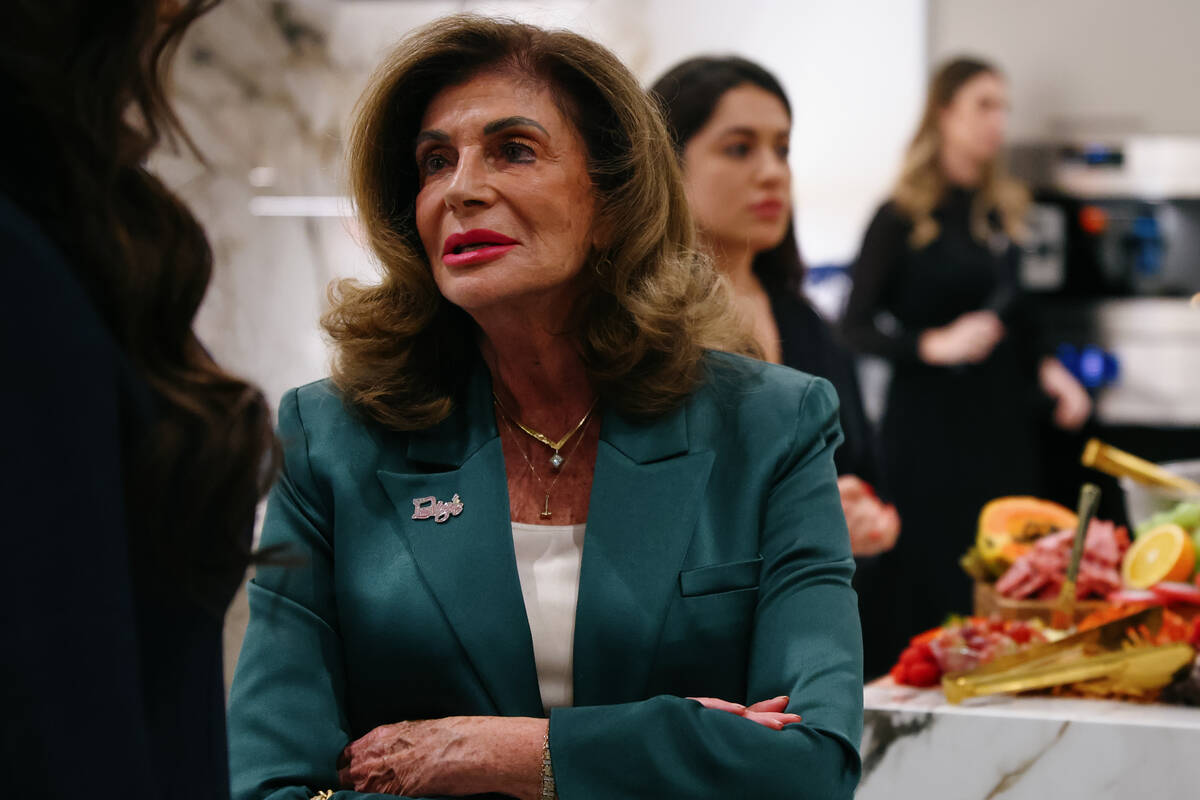
Shortly before voting to affirm last month’s primary election results, Las Vegas Mayor Shelley Berkley expressed disappointment that fewer than 20 percent of registered city voters cast ballots.
“The frustration I have is the lack of participation in our voting process,” she told LuAnn Holmes, the city clerk who had presented the numbers on June 18.
It’s not like Nevada hadn’t promoted voting through universal mail ballots, educational programs, early voting and a numerous polling locations across the valley on Election Day, Berkley said, congratulating Holmes for an otherwise successful election process.
In Nevada, it is so easy to vote, the mayor lamented.
“Is there anything that we are missing here, that the city could be doing to encourage people to exercise the most sacred right of being an American citizen, and that is voting for your elected officials?” Berkley asked Holmes.
They agreed to discuss the topic further.
Experts argue that Nevada’s closed party primaries, gerrymandering, noncompetitive races and overall political apathy might be leading to fewer citizens to vote.
Low participation
Clark County reported an 18.3 percent participation rate among 1,511,315 registered voters, a rate similar to Las Vegas and below Nevada’s turnout of 21.8 percent.
Participation among the county’s nonpartisan voters was even lower — 6.4 percent — despite being the largest voting block ahead of Democrats and Republicans.
Over the last dozen primary elections since 2002, Nevada’s voter turnout rate has fluctuated between 16.2 percent in 2024 and 30.1 percent in 2010.
Clark County had its worst turnout in the primary election of 2006, when only 13,186 voters cast a ballot, a 2.1 percent participation rate.
Secretary of State Francisco Aguilar said that Nevada’s automatic voter registration, implemented through a 2018 ballot question, impacts the data.
“In whole numbers, the total number of voters has increased,” he told the Las Vegas Review-Journal. Voter participation also increases substantially during general elections, he said. The 2008 and 2012 November cycles saw rates of about 80 percent.
Aguilar credited competitive races in Washoe County, including the contest to replace Rep. Mark Amodei, R-Nev., for that county’s 30.8 percent turnout in the recent primary election.
He said congressional races in Southern Nevada, the governor’s race and the contests for mayoral seats in North Las Vegas and Henderson might drive turnout in November.
“Those types of races will turn people out at the local level, which then turn into a higher turnout, hopefully, at the constitutional statewide level,” Aguilar said Thursday.
‘What am I supposed to do?’
Sondra Cosgrove, College of Southern Nevada social sciences professor, told the Review-Journal that Nevadans she’s spoken to recently told her they had little to vote for.
“And I hear this from voters, especially young voters,” she said. “They’re like, ‘I vote and nothing changes. So why am I voting?’”
Nonpartisan voters in Nevada have even fewer options, because their ballots are limited to nonpartisan contests, such as municipal government seats or less-known judicial positions.
Cosgrove said that those would-be voters have told her they don’t know enough about the candidates to choose.
“They just look at those races and say, ‘I don’t really see how this is going to be worth my time,’” she said.
Candidates, voters raise alarms
Cosgrove, who is also the executive director and chair of Vote Nevada, a civic engagement nonprofit, is a proponent of open primaries and ranked-choice voting.
Legislative efforts to open primaries have failed. So did ballot Question 3 in 2024, which would’ve created open primaries and ranked-choice voting. At the time, the Democratic and Republican parties opposed the initiative.
Cosgrove theorized that parties support the current system as a way to maintain control. However, she said she’s heard from rank-and-file elected officials and voters who have raised alarms over the status quo.
“I think until we get to a point where nobody’s voting, I don’t think there’s pressure to actually move everything else to an open primary,” she said. “But if we get to the point where we’re at like 2 percent of the people voting, that’s not democracy, and that’s a house on fire.”
Aguilar doesn’t disagree that closed primaries disenfranchise nonpartisan Nevadan voters. He testified in favor of a 2025 bill that would’ve opened them.
He countered that Nevada’s same-day registration gives nonpartisan voters options.
“You can re-register to a party that you want to participate in, and then re-register back to nonpartisan for the general or future elections,” Aguilar said.
Candidates and parties can drive turnout
Aguilar, Nevada’s chief election official, touted the state’s get-out-the-vote efforts, including educating the youth about civic engagement.
Nevertheless, he supports the prospect of more competitive races, a responsibility that primarily falls on the parties and candidates, he said.
“First, our responsibility is to make sure we’re running safe, secure and accessible elections, which Nevada does,” Aguilar said about his office. “Next is figuring out how do we make sure the clerks are ready and prepared to go.”
After that, it can focus on voter turnout, he added.
“We can only do so much,” Aguilar said. “And yes, I enjoy talking to young people to get them motivated to turn out. But in reality, we have our first responsibility: the administration of the election.”
Contact Ricardo Torres-Cortez at rtorres@reviewjournal.com.