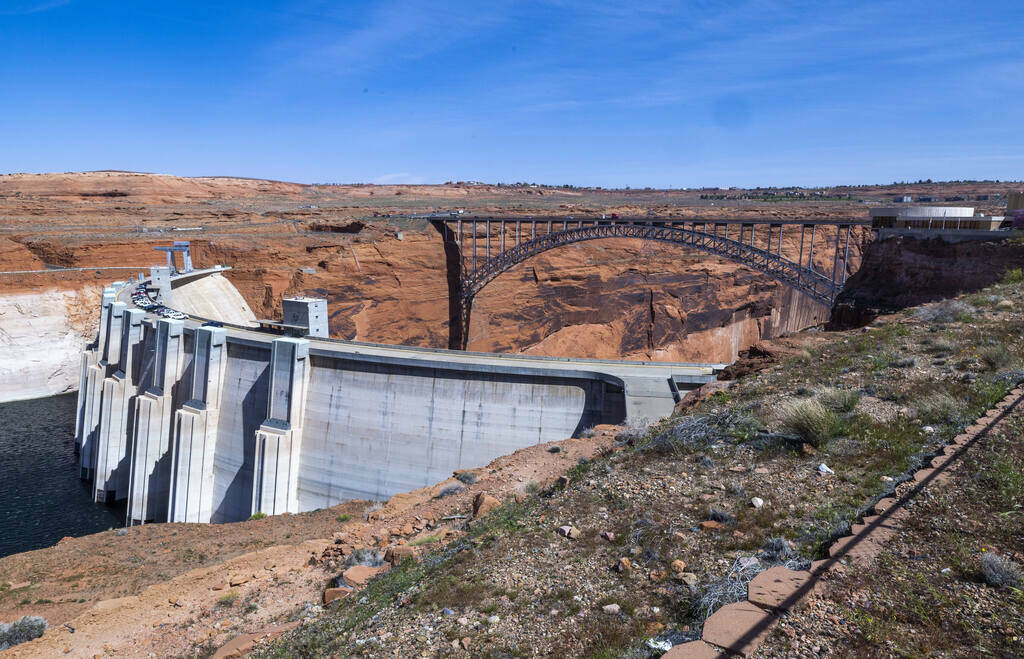
When the Bureau of Reclamation announced it would cut releases into Lake Mead in an effort to prop up Lake Powell, the messaging was clear, and it acknowledged a problem some in the Western water world have raised for years.
“If Glen Canyon Dam declines below 3,490 feet, water releases would be only through the river outlet works, which could cause operational issues, uncertainty for users, downstream impacts, instability in regional power and water supplies, and a reduction in power generation,” a news release said.
To many, the functionality of Glen Canyon Dam’s river outlet works has been a slow-moving crisis. If levels at Lake Powell fall too low, water deliveries to Lake Mead could be cut off due to potential damage of those release tubes, spelling trouble for Southern Nevada and its neighbor states in the Lower Colorado River Basin.
“The whole flow of the Colorado River and all of the deliveries to the Lower Basin could all hinge on these steel tubes that were never meant to convey the whole flow of the Colorado River,” said Eric Balken, executive director of the nonprofit Glen Canyon Institute. “That’s so much uncertainty that very few stakeholders are comfortable with.”
The Southern Nevada Water Authority said as much in a March letter introducing its stopgap proposal to stabilize the river system. The letter said that the Bureau of Reclamation’s “shortsighted” move at Lake Mead’s expense was an attempt to “protect Glen Canyon Dam’s river outlet works by reducing releases from Lake Powell.”
Deciding to reduce downstream releases to avoid low elevations upstream is one of the reasons why Lake Mead could be headed for its lowest levels ever. The latest 24-month federal projection shows the reservoir’s water level plunging in 2028 some 29 feet below its lowest level ever recorded.
At a congressional committee hearing this month, Andrea Travnicek assistant Interior secretary of water and science, called concerns about the river outlet works part of “false narratives.” A 2024 internal memo from the federal government had previously cast doubt on the long-term performance of Glen Canyon Dam at low reservoir levels.
“You can use some of those river outlet works,” Travnicek said. “They have been tested; they will be able to be used. However, as we’re trying to make sure we’re managing water responsibly in this basin, I don’t know why we want to continue to draw (Lake Powell) down when we have other opportunities.”
What has changed?
When asked to expand on Travnicek’s comments, Bureau of Reclamation spokesman Peter Soeth said the agency believes the river outlet works can be used continuously, but only with “more frequent inspections and maintenance.”
“The river outlet works are a critical tool — but they are not the preferred sole release pathway,” Soeth said. “They are not intended to replace the penstocks as the main release mechanism, and maintaining Lake Powell above 3,500 feet remains critical for long‑term system performance, hydropower and infrastructure health.”
That doesn’t mean re-engineering the dam isn’t a priority or a possibility. By the end of 2026 or in early 2027, Soeth said the agency plans to release an appraisal study for three dam modification alternatives.
Any big undertaking beyond appraisal lacks dedicated funding, however, Soeth confirmed.
In a Friday statement, the Southern Nevada Water Authority said the uncertainty of Glen Canyon Dam’s infrastructure is another reason for every state to take swift action to cut water use in order to protect reservoir storage.
“While Reclamation has acknowledged the engineering feasibility exists to operate at these levels, the bypass tubes were not envisioned to be the sole release mechanism,” the statement said. “Gambling on how much we can safely release while the reservoir is near empty seems less than prudent.”
Balken, of the Glen Canyon Institute, said that questions remain about what he sees as “mixed messages” from federal officials. Hydropower generation alone isn’t a good enough reason to prop up Lake Powell, Balken said, especially considering that many utilities have phased the small amount they use from the dam out of their portfolios.
At a recent conference at the University of Colorado, Boulder, Balken said a presentation laid out the functionality issues of the dam and suggested they could work, while an official said in his speech later that engineers are not comfortable relying on the tubes.
“They’re trying to project confidence in this in the river outlet works: They’re saying ‘We can use these; it’s fine. Don’t worry about it. Nothing to see here.’ At the same time, they’re saying, ‘Oh, that wasn’t designed for this.’”
While Balken’s organization advocates for the eventual decommission of Glen Canyon Dam and Lake Powell for the good of the ecosystem, he said he recognizes why the Trump administration is pointing to the basin’s severe supply and demand issues rather than faulting the river outlet works.
“If I were in their shoes, I’d probably be saying the same thing,” he said. “But I would also be proactively seeking re-engineering options.”
Contact Alan Halaly at ahalaly@reviewjournal.com. Follow @AlanHalaly on X.