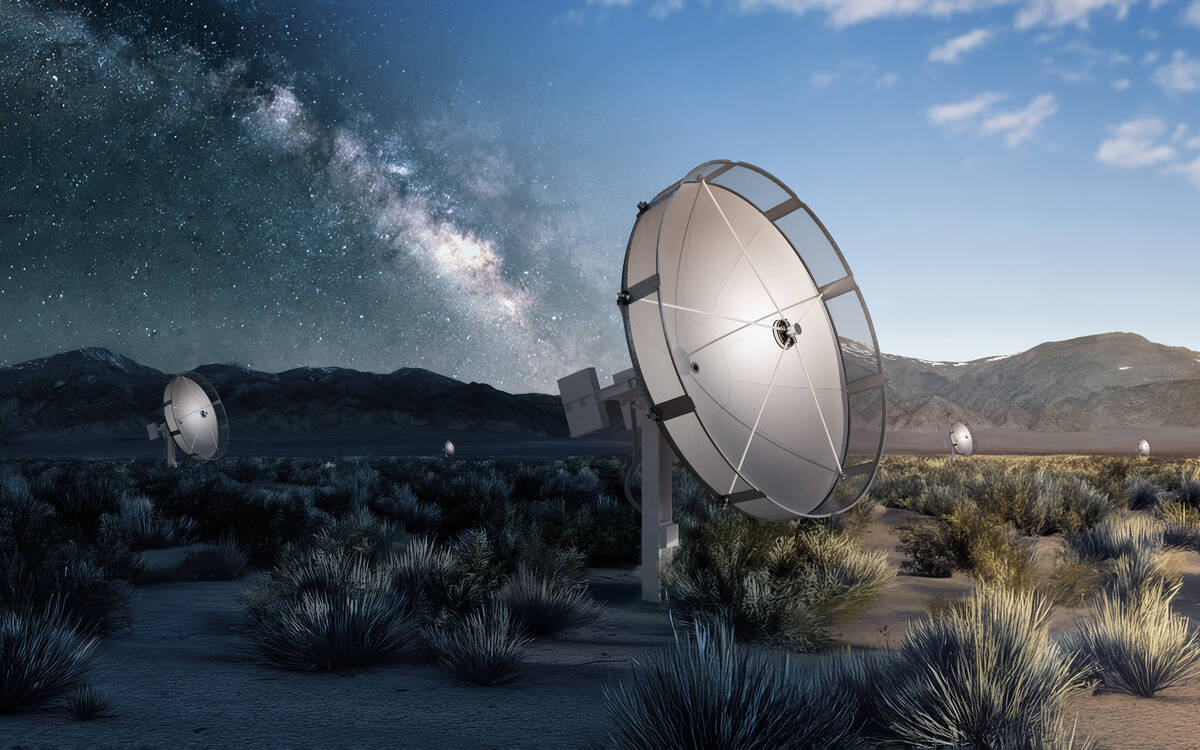
A California university plans to build more than 1,600 radio dishes in a remote Nevada desert to scan the sky for radio signals from stars, galaxies, black holes and other mysteries of space.
The cluster of 1,650 dishes — each with a diameter of about 20 feet — will comprise the Deep Synoptic Array project, touted as the “World’s Most Sensitive Radio Telescope.”
Led by the California Institute of Technology, the endeavor is being funded by the Schmidt Sciences philanthropic foundation. Caltech announced Thursday that the foundation had greenlit its design, with total completion estimated by 2029, and “science operations commencing soon after.”
The university could not be reached for comment, although Physics Today reported in August that the project was planned for a remote Nevada town about an hour drive away from Ely. The publication added that construction was expected to cost about $200 million.
The science of scanning radio waves in space, which are many times lengthier than visible light, is known as radio astronomy. Caltech is a pioneer in the field.
The DSA project will survey the visible sky at unprecedented speeds, said Gregg Hallinan, program leader and Caltech astronomy professor, in a statement.
“While all other radio telescopes combined have so far found about 20 million radio sources, the DSA will match that in the first day of operations, said Hallinan, who also is the director of the university’s Owens Valley Radio Observatory. “By the end of its initial survey, it will have discovered about 1 billion new radio sources.”
Vikram Ravi, co-principal investigator of the DSA and Caltech astronomy professor, said that the project will propel the science from “sketch to photograph.”
This is a developing story. Check back for updates.
Contact Ricardo Torres-Cortez at rtorres@reviewjournal.com.