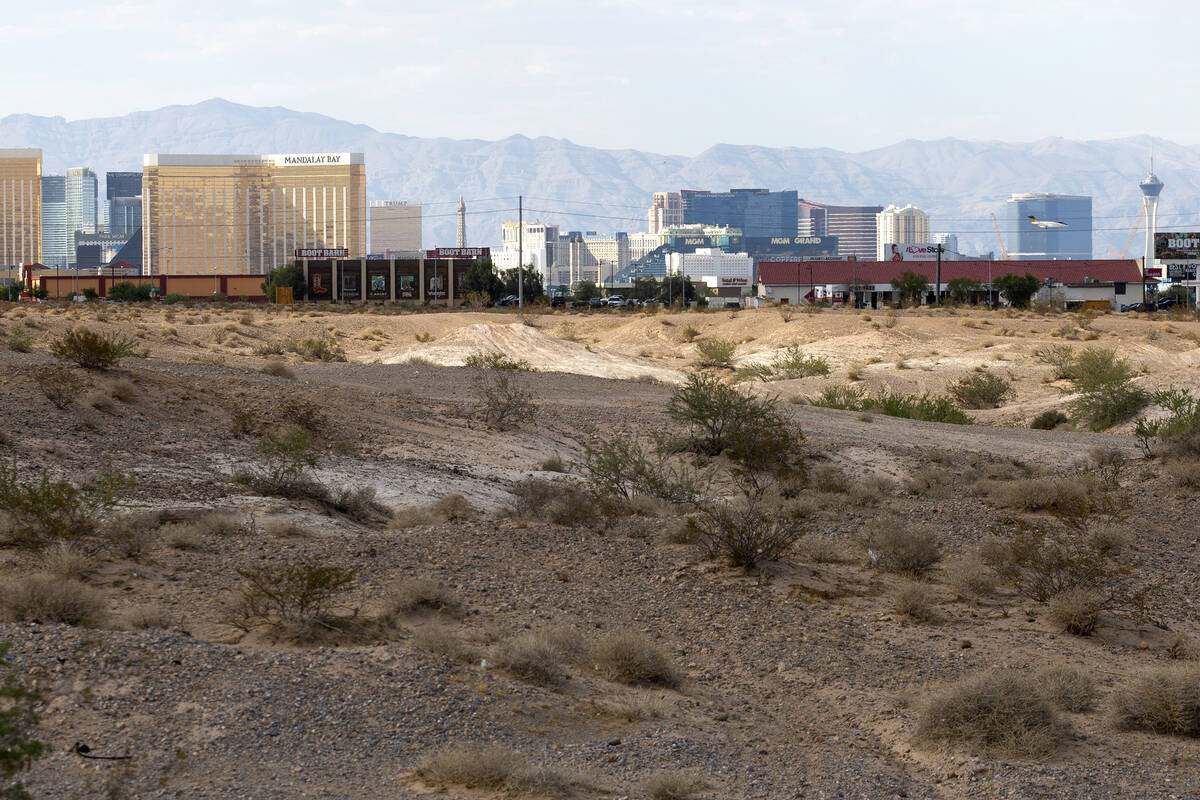
Las Vegas homebuilders want more land on which to build. The federal government owns many undeveloped parcels in and around the Las Vegas Valley that have been approved for sale.
This seems like a problem with an obvious solution. But something has gone wrong.
Last year, the federal government sold off just 41.8 acres in the Las Vegas Valley. That was the lowest number since the Great Recession. For 2023 and 2024 combined, the federal government sold nearly 600 acres. In 2003-04, Washington sold more than 5,400 acres.
Part of the problem is the convoluted process for releasing government property. The federal government doesn’t simply put out a “for sale” sign. Builders have to nominate a parcel for sale. Jumping through those bureaucratic hoops usually takes 12 to 18 months.
That’s only the start of the difficulties. The federal government then holds an auction, but buyers must pay at least the fair market value of the land. In a competitive market, that wouldn’t be a problem. But the federal government controls 88 percent of the land in Clark County.
The Beltway’s vise grip on property in Southern Nevada has produced an artificial shortage of developable land. And when supply is limited but demand is high, prices shoot up.
If a private company operated this way, progressives would deem it a monopoly and push for intervention. But federal officials have shown no interest in applying that standard to themselves.
Developers also face another hurdle. The federal government demands 20 percent of the purchase price immediately. The remaining amount must be paid within 180 days. But builders say that doesn’t give them enough time to do a tentative site map and get local approval for their projects.
It wasn’t supposed to operate this way. In 1998, Congress — thanks in large part to Democratic Sen. Harry Reid — passed the Southern Nevada Public Land Management Act. It identified around 67,000 acres that were to be sold for development.
For context, the federal government owns around 4.5 million acres in Clark County.
It’s unlikely such a bill could pass today, given that Democrats and many on the left now cynically accuse those who advocate that the BLM rid itself of an infinitesimal portion of its massive Western real estate portfolio of wanting to auction off Yellowstone, Red Rock or Yosemite. In fact, the land management act didn’t call for the divestiture of sensitive land — quite the opposite. The legislation allows the BLM to use the sales proceeds, in part, to purchase land elsewhere in the state for protection. In fact, the law hasn’t led to a noticeable reduction in the amount of Nevada land that Washington “manages.”
Yet the BLM continues to slow-walk the process after almost three decades.
“The idea was for the BLM to be totally out of the urban land management business in the valley within five to 10 years,” Mike Ford, a former BLM official and one of the owners of the public lands consulting firm, Las Vegas-based Abbey, Stubbs &Ford, said about the 1998 law. “And that hasn’t happened.”
Nearly 30 years later, around 40 percent of that land still hasn’t been sold. That is not acceptable, particularly regarding property near developed urban areas. Nevada needs a modern-day Theodore Roosevelt to trust-bust the federal government’s control of land in Southern Nevada.