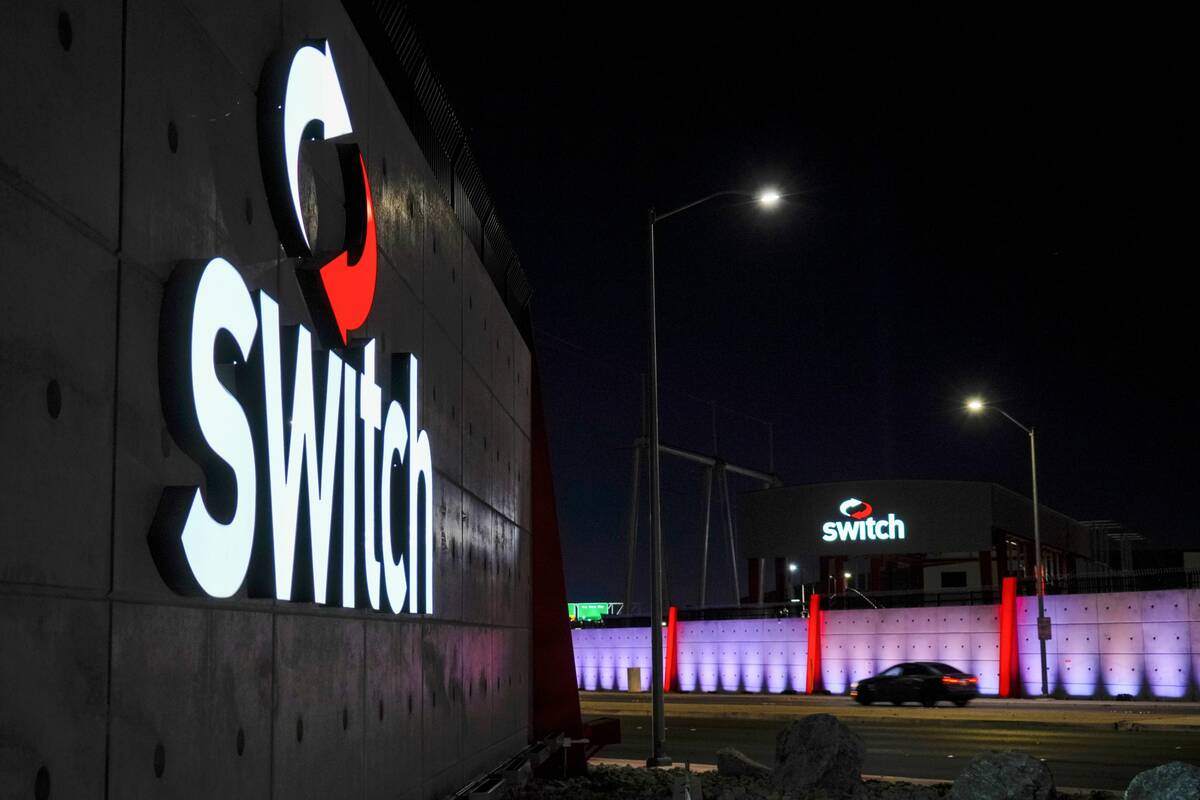
Data-center owner Switch is expanding to a new state and raising more money, amid America’s heated growth of digital storage space — a rapid industry increase that has rankled communities around the country.
Las Vegas-based Switch announced plans last week to develop a 382-acre data-center campus outside Pittsburgh, saying the sprawling complex will serve customers concentrated in the Eastern U.S.
It did not provide a construction timeline or cost estimate in the release. But it said the campus, in Big Beaver Borough, Pennsylvania, would join Switch’s portfolio of facilities in Nevada, Texas, Michigan and Georgia.
“We are excited to invest in this region and partner with the community to be a responsible, long-term neighbor,” Natalie Stewart Mitchell, senior vice president of government affairs and campus development at Switch, said in the April 30 news release.
Switch also said that it is “committed to funding the infrastructure required for its power needs, consistent with an approach that does not pass costs onto consumers,” and that its proprietary design “uses a closed-loop system that recycles water, minimizing consumption and eliminating discharge.”
The news followed Switch’s announcements last month that it secured a $2.6 billion syndicated letter of credit and that it raised nearly $770 million through another bond sale.
All told, Switch has borrowed billions of dollars over the past few years to fund its growth and loaded up on land in Southern Nevada, laying the foundation for new data centers locally and around the country.
‘Data centers are amazing. Everyone hates them’
Data centers are basically warehouses filled with computer servers and other gear needed to store clients’ data, and construction has been spreading fast in the U.S. amid the rapid development of, and heavy investments in, artificial intelligence.
Overall, the U.S. had more than 4,100 active data centers and nearly 2,800 others that were under construction or announced, according to a report in December from tech advocacy group the American Edge Project and the Technology Councils of North America.
But amid fears that employers will shed waves of white-collar workers and replace them with AI systems — and concerns by environmental groups and others over data centers’ effects on surrounding communities — there has been pushback around the U.S. to the rapidly growing industry.
“Data centers are amazing. Everyone hates them,” declared a headline in MIT Technology Review in January.
The facilities typically rely on water to help cool the servers, an issue that has drawn increased attention locally as Southern Nevada grapples with a decades-long drought and a deeply shrunken Lake Mead, the reservoir that supplies about 90 percent of the Las Vegas area’s water.
Since 2024, a ban on evaporative cooling systems was finalized in Southern Nevada, effectively eliminating the possibility of constructing data centers that are more water-intensive.
In response to community concerns over water, Nevada lawmakers have floated a statewide ban on evaporative cooling. Advocates have also pushed for requirements that data centers use clean energy and are placed in their own consumer class to shield utility ratepayers from rising costs.
Also, some Boulder City residents have protested the first data center proposed within city limits as voters there face a ballot question in November on whether the facilities should be allowed in parts of the outlying Eldorado Valley.
Las Vegas grown
Locally, the data-center industry is all but synonymous with Switch, a homegrown company founded by Rob Roy with several big facilities in the southwest valley area.
In 2022, investment firms DigitalBridge Group and IFM Investors acquired the company in a deal valued at about $11 billion.
Last summer, Switch announced that it had borrowed $20 billion since 2024 to support the growth of its campuses around the country, reduce its cost of capital, and fully retire the bank debt incurred in the buyout that took the company private.
It also said last fall that it had borrowed around $3.5 billion through bond sales.
Switch has been building so-called AI factories in the southwest valley. As the company previously explained, these are smaller than its typical data centers in Las Vegas but are more densely packed with computing power, as they are designed to power AI systems.
In recent months, Switch also purchased 300-plus acres of land in North Las Vegas’ Apex Industrial Park for more than $180 million combined through two separate transactions, the Las Vegas Review-Journal reported.
It’s not the only data-center firm with a big foothold in the remote industrial park.
Last summer, Utah-based Novva Data Centers acquired nearly 205 acres in Apex for almost $181 million, the Review-Journal reported.
Contact Eli Segall at esegall@reviewjournal.com or 702-383-0342. Review-Journal staff writer Alan Halaly contributed to this report.