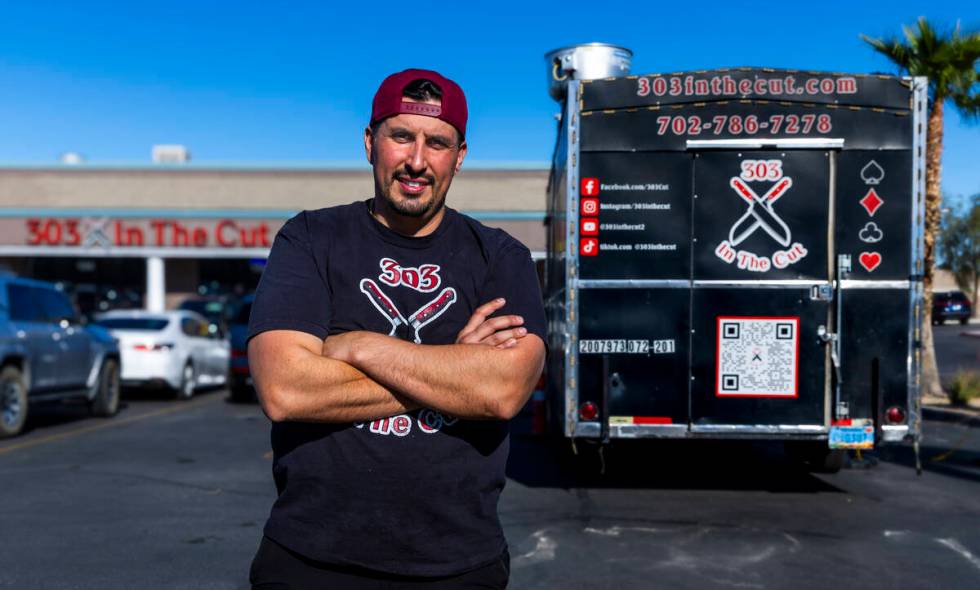
Banks weren’t exactly tripping over themselves to loan a 20-something recovering addict with zero kitchen experience $2 million to open a gourmet drive-thru.
So Guiliano Raso buckled down, worked six and seven days a week at three jobs for almost three years, put away six figures and set up a food truck in the parking lot of a Chinatown strip club.

That business, 303 in the Cut, has expanded to a second truck at Centennial Hills Hospital and a new bricks-and-mortar restaurant in the southwest valley.
Along the way, Raso started assisting other local small-business owners in ways he could only have dreamed of being helped.
“I try to encourage those entrepreneurs and business owners,” he says. “Like, ‘Hey, I’ll show you. I’ll show you exactly what I did. There’s no secrets behind it. I don’t gatekeep. I wanna give you all the information I can.’ ”

Burritos and tiramisu
None of this should’ve worked. Not a bit of it.
For starters, not only wasn’t Raso a chef, he didn’t know how to cook. All of his restaurant experience was front of house — bartending, serving and the like.
So he’d read and watch YouTube videos. He’d pay for the ingredients to feed a chef’s family for a night in exchange for, say, that chef showing him different ways to fry chicken.
“I took stuff from around the country that I really loved,” Raso says, “and I put it on the menu.”
Much like the furniture in your first apartment, nothing on that menu goes together.
The top seller is the burrito ($13.50) stuffed with smoked chicken, pinto beans, cheese and Colorado green chile. But 303 in the Cut may be most famous for its tiramisu ($13.50), a serving of which can tip the scales at a pound.
Another viral dessert, the cheesecake sandwich ($16.50), comes with “Cutty Cream” and jam to pour between two slabs of cheesecake.
There’s also the Cutty Cheesesteak ($13.50) and the Dirty Dog ($14.50), which is basically that cheesesteak atop a deep-fried hot dog.
The Crackin’ Fried Chicken Fries ($18.50), though, are something of a masterstroke.
“Our fried chicken, it’s a three-day process,” Raso says. “It’s a huge pain in the a—. I shouldn’t have done it. But now we’re stuck doing it.”
Jumbo chicken tenders are brined in buttermilk, kiwi and salt for 48 hours, then hit with a flour, egg wash and panko finish. They sit overnight, he says, so the panko “almost becomes part of the chicken.” Once they’re cut into chunks, they’re heaped upon seasoned fries and cheese sauce before the whole thing is smothered in roasted garlic aioli and the proprietary 303 Sauce.
Raso taught himself how to prepare all of it.
“I can make everything on our menu. I’m kinda slow at it because I don’t do it anymore,” he acknowledges. “But you ask me to make a lobster bisque with salmon? You do not wanna eat my food. That’s not me.”

‘I came here with my back against the wall’
Raso was living in Arizona in 2015 when he finally got clean, kicking a daily habit of smoking crack and shooting heroin.
“I just felt alone,” he says of those days before rehab. “I realized I was at such a bottom in my life.”
Three years later, the restaurant idea came to him. After that plan morphed into the food truck, Raso moved to Las Vegas, where he’d gone to Shadow Ridge High School. Even in familiar territory, that loneliness caught up with him.
“Came back to a town where I didn’t know anyone,” he recalls. “I didn’t have any connections. I came here with my back against the wall.”
Raso sent out hundreds of emails, direct messages and handwritten letters seeking mentorship and guidance.
It’s been awesome because, along the way, people started asking for my help to make videos. So I started making videos for them. It made me feel good. I liked it.
Several months later, on his 33rd birthday, Raso woke up to an email from Denny Warnick, the chief operating officer at In-N-Out Burger.
“We check in every couple of months. He gives me so much feedback,” Raso says, scrolling through lengthy email exchanges between the two. (The In-N-Out marketing team declined an interview request on Warnick’s behalf.)
“People are like, ‘Why don’t you do this or do that?’ I’m like, ‘I asked In-N-Out, and In-N-Out suggested I do this. Am I gonna listen to you or am I gonna listen to In-N-Out?’ ”
The only other response from those hundreds of lifelines came from Colin Fukunaga, who started Fukuburger out of a food truck in 2010.
“You’ve gotta find someone who’s at a level you aspire to be at and follow their lead. Colin is that for me. He’s the GOAT of food trucks in this town,” Raso says. “Everything he told me to do, I listened to him, but I multiplied it by a hundred.”

A local mentor
Fukunaga and Raso bonded over their sobriety, something the former achieved a decade ago.
“I almost lost everything to gambling and drinking,” Fukunaga says. “A free service in town, Problem Gambling Center, helped me save my own life. I owe my community so much.”
That, along with his parents’ instilling in him the need to give back, helps explain why he was so willing to aid Raso and other business owners over the years.
“I had some really, really great mentors that were about the long game,” Fukunaga says. “And how to retain your staff is an art form by itself, to make sure that you’re going to retain your guests. ‘Happy staff equals happy guests’ has always been one of the cornerstones of my philosophy in this business.”
Fukunaga recommended the original truck’s late-night hours — 7 p.m. to 1 a.m. in front of Play it Again Sam’s at 4120 Spring Mountain Road — because lunch, at least during the week, is when people eat for sustenance, seeking out places that are nearby and quick. The second truck, at 6900 N. Durango Drive, is open from 5 to 10 p.m.
I almost lost everything to gambling and drinking. A free service in town, Problem Gambling Center, helped me save my own life. I owe my community so much.
He also emphasized the customer experience over speed, telling Raso to get out of the truck, stop taking orders and meet the people he’s feeding.
“I walked that line and talked to every single guest for at least a year and a half,” Raso says.
Perhaps his biggest takeaway involved social media and the fact that he needed to do it himself and be the face of 303 in the Cut.
“I said, ‘They wanna hear your voice,’ ” Fukunaga recalls. “When people open up (food concepts), I always tell them, ‘Part of the show is you, the owner. They wanna know what was your inspiration. They wanna know why they’re eating this. Why they’re paying for this.’ … It makes it so much sexier when they’re eating and they get to talk to the owner. They’re like, ‘That’s why I come here, and I keep on coming back here.’ ”
“With the social media,” Fukunaga adds, “he’s such a hustler. … He’s grown his social media out of this world.”

A viral sensation
The first 303 in the Cut — the name combines the area code from Raso’s native Colorado with the street slang for a place that’s hard to find — opened in August 2021.
That November, the food truck was pulling in just $200 to $300 a night.
Raso was posting a video a day on Instagram and TikTok, and by the following November, he was up to about $2,000 a night.
“I was still broke,” he says, “but I was like, ‘Yo! I’m gonna pay myself this year. This is f—— awesome!’ ”
Then, everything changed.
At least one of Raso’s videos was seen by a local MMA fighter with a career record of 8-5 who was looking to reinvent himself. He went to the truck, bought one of pretty much everything and, on Nov. 14, 2022, posted a TikTok of him eating and raving about the food.
The result was the first known instance of “The Keith Lee Effect,” essentially putting both the truck and the burgeoning food influencer on the map.
That video went so viral, three days later there were 147 people in line waiting for Raso to open. The TikTok has since been liked by 7.2 million people.
“I had a line every day for two years,” Raso says. “Whether it was two or three people in line, we didn’t stop, from the minute we opened to the minute we closed, for two years.”
These days, Raso posts five to 10 times a day to his 322,000 followers on Instagram and his more than 405,000 followers on TikTok.
The videos have a direct, in-your-face style. Nothing fancy. Zero edits. They consist almost entirely of Raso, wearing a black 303 in the Cut T-shirt and a backward ball cap, looking into the camera and highlighting one menu item. At the end, he implores viewers to come have their “late-night get right” and to “mess around, find out, see what’s up.”
Beyond that, Raso uses his Instagram Stories to share videos from other small businesses.
“It’s been awesome because, along the way, people started asking for my help to make videos,” Raso says. “So I started making videos for them. It made me feel good. I liked it.”
That isn’t limited to other restaurants and food trucks. In recent weeks, Raso posted video testimonials for Vanity Polish Nails & Spa, Creative Minds Tattoo, Ashton’s Classic Barbers, Modern Balloon Events and JCR Mobile Sharpening for all your knife and scissor needs.
He’ll even spotlight direct competitors.
“There’s other cheesecake in town that I love. I promote them all the time,” Raso says. “CinCityCheesecakes. Love their cheesecake. Do it all the time. Because I’m not scared of competition. There’s plenty for all of us out there.”

‘He’s the bright light in the darkness’
Rudy Hernandez and his wife, Nohely, opened La Churrera in December.
They’d seen Raso’s videos promoting small businesses. A month before launching their filled churro wagon, Nohely direct messaged him out of the blue to ask for help.
“I thought it was a long shot,” Hernandez says. “ ‘Yeah, right. You’re messaging Tom Cruise, and you’re expecting him to respond back to us.’ ”
Raso replied within half an hour.
“We had no idea what we were doing,” Hernandez says. “We didn’t even know where to start. That’s how lost we were. He’s the bright light in the darkness. He was very, very helpful. I’ll always appreciate him for that.”
I thought it was a long shot,. ‘Yeah, right. You’re messaging Tom Cruise, and you’re expecting him to respond back to us.’
Raso assisted with everything from the basics of health permits and licensing to what hours La Churrera should be open.
“Just the fact that it came from him holds so much weight because of what he’s accomplished already,” Hernandez says.
The only thing Raso asked of them was to pay it forward.
The other day, someone told Hernandez they were thinking about starting a food truck.
“Immediately, I thought of him,” he says. “I told that guy, ‘Here’s my number and my email. Anything I can help you with, any answer I can give you. Any question you’ve got, I will answer. Because that’s how somebody treated me.’ ”

Looking to the future
The bricks-and-mortar 303 in the Cut opened in April at 8090 S. Durango Drive. Given the economy, it was admittedly not a great time for expansion.
“I’m not scared of failure,” Raso says. “I’ve been at real low points in my life. I’m very grateful for where I am. This is easy compared to how I used to live.”
He’s gone from doing most everything himself to looking after roughly 25 employees.
“When I hire people, I don’t hold their past against them,” he says. “There’s always a chance for people to change their life for the better, and I’m a testament to that.”
Raso wants to get to a place where he can provide those employees with healthcare and 401(k)s. And he’s still working toward that drive-thru.
“We’re gonna be as big as In-N-Out and Chick-fil-A in the next 30 to 40 years. That’s our goal as a company. That’s where we’re going,” Raso says. “And I say it out loud, and I manifest it. Speak it into existence. People think I’m crazy. But people also thought I was crazy when I was moving to Vegas to start a food truck, and here we are in our third location.”
Contact Christopher Lawrence at clawrence@reviewjournal.com or 702-380-4567.