Clark County officials have launched an online dashboard that allows the public to track real-time coroner’s office data about how people died.
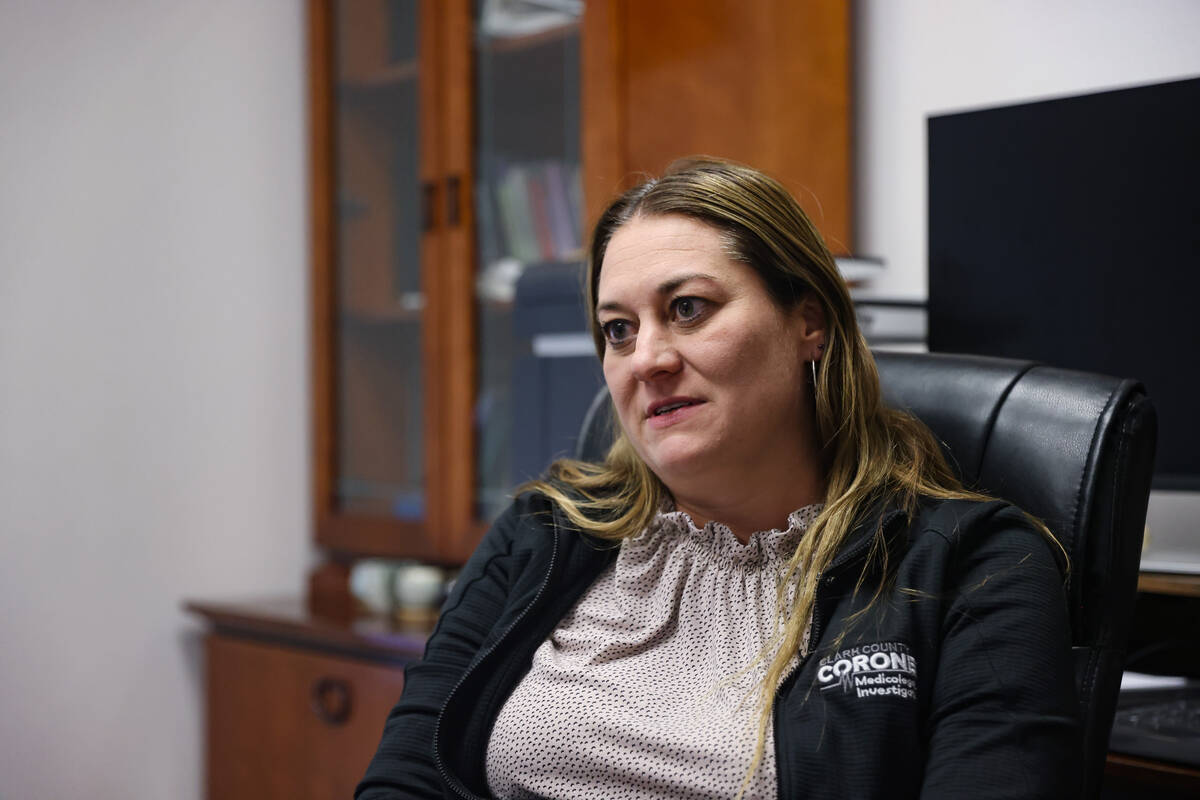
“I really wanted to get to where we were sharing information and being transparent as to what we’re seeing in our communities,” Melanie Rouse, the coroner of nearly five years, told the Las Vegas Review-Journal during an interview to discuss her office’s 2025 statistics.
Last year, the office saw drops in homicides, drug deaths, and heat fatalities compared with 2024, according to figures provided by Rouse’s office.
The Clark County coroner’s office investigates all deaths in the county that occur outside a medical setting, including those that are natural, sudden, accidental, or the result of homicide.
The office conducts autopsies, confirms identifications, and locates next of kin. In addition to Clark County, it serves Lincoln, White Pine, and Nye counties.
The coroner said that determining cause and manner can take up to three months in 90 percent of cases, so data for the previous year is often not available until around April.
That information is now available for public access on clarkcountynv.gov.
Homicides
The coroner’s office investigated nearly 6,000 deaths last year. The leading causes of death trends were similar to those in 2024, including cardiovascular issues, drug toxicity, and traumatic injuries, she said.
Rouse said that homicides have continued to decline since 2023.
Although the Metropolitan Police Department reported a 22 percent decrease in murders within its jurisdiction, the coroner’s office recorded 178 homicides in 2025, compared with 197 homicides in 2024, indicating a much smaller decline within the county.
Rouse noted that her office and Metro count killings differently.
“Our ruling of homicide does not necessarily equal criminal activity,” Rouse said. “Our homicides are defined by deaths that occur at the hands of another person. So in some jurisdictions, for example, law enforcement, they may classify their homicides or their murders, if you will, cases based on criminal components.”
Metro reported 117 homicides, which include self-defense killings, in 2025. Metro does not include fatalities from police shootings in its homicide statistics, but the Clark County coroner’s office does.
Homicides involving firearms still make up the bulk of the cases, where victims are largely Black. Men were about 3 1/2 times more likely than women to be homicide victims in 2025.
Most victims were 18 to 40, according to data provided by Rouse, who said the trend may be linked to lifestyle and socioeconomic differences compared with younger and older populations.
“But again, you have to use caution when you’re talking about some of these complex cases, because some of them do take a lot longer for us to get to a cause and manner of death,” Rouse said. “So we may still be under investigation in some of the cases that are still pending from last year.”
‘Providing safe steps’
Drug-related deaths accounted for nearly one-fourth of the coroner’s cases in 2025.
Still, the office reported a drop of more than 100 drug fatalities, falling to 1,228 from 1,389 in 2024.
Rouse attributed the reduction to a tapering of the fentanyl epidemic, a trend also seen nationwide.
“We’re providing safe steps, step test strips for things like fentanyl, or we’re getting more of naloxone out in our community,” Rouse said. “Those things do help.”
Deaths among the homeless also fell by about 16 percent, with 328 dying in 2025. More than half of those deaths were drug-related, while about 10 percent were linked to heat.
Rouse said certain drugs, including fentanyl, can increase vulnerability to heat-related death. Those fatalities dropped by nearly half in 2025.
Heat was a factor in 257 deaths in 2025, down from 443 the year before.
Rouse said the decline was driven by expanded cooling centers, free bus passes, and increased public messaging about heat safety, along with fewer days reaching 100 degrees in 2025 compared to 2024.
“As far as the data and trends go, 2025 was good to us for heat-related fatalities,” Rouse said.
Robert Banghart, who works with CrossRoads of Southern Nevada, a substance treatment center, and Shine A Light, a nonprofit serving those living in the Las Vegas Valley’s underground tunnels, cautioned against taking year-to-year changes at face value.
From 2021 to 2024, deaths among people experiencing homelessness and drug fatalities climbed steadily, according to data provided by the coroner.
Banghart noted that while Clark County’s overdose fatalities declined in 2025, statewide figures continue to rise.
“There are years when the weather is a little better, and there are more organizations doing the work,” Banghart said. “I hope it’s a pattern that will continue, but I don’t think one year is enough to hang our hats on.”
What this summer could bring
Last month, Las Vegas came close to recording the valley’s earliest 100-degree day, but fell three degrees shy. Still, there were three days of record-breaking heat, with Harry Reid International Airport setting all-time March highs above 90 degrees.
At the time, county officials announced the activation of more than a dozen daytime cooling stations scattered throughout the valley.
Rouse said Clark County has already recorded at least one heat-related death as of April and expressed concern about what this summer could bring.
“It raises a red flag to me,” Rouse said. “We try to work with our public health partners to, one, get information out there, and then two, to provide some intervention services to try to protect our communities as best as we can.”
Contact Akiya Dillon at adillon@reviewjournal.com.