Question: I like to challenge myself physically, whether it’s working out, cycling or cross-country skiing. I’ve heard about VO2 max testing. What could I gain from it?
Answer: A VO2 max test measures the amount of oxygen you breathe in and use at peak levels of exercise intensity, and it assesses how well your heart, lungs and muscles work together during aerobic (cardio) exercise. Whether you’re an athlete or not, a VO2 max test can provide insights into your cardiopulmonary fitness.
Because of the cost and specialization of the equipment, a VO2 max test is typically conducted in a sports medicine setting or an academic exercise science department. Be sure to check with your insurance provider to see if this service is covered.
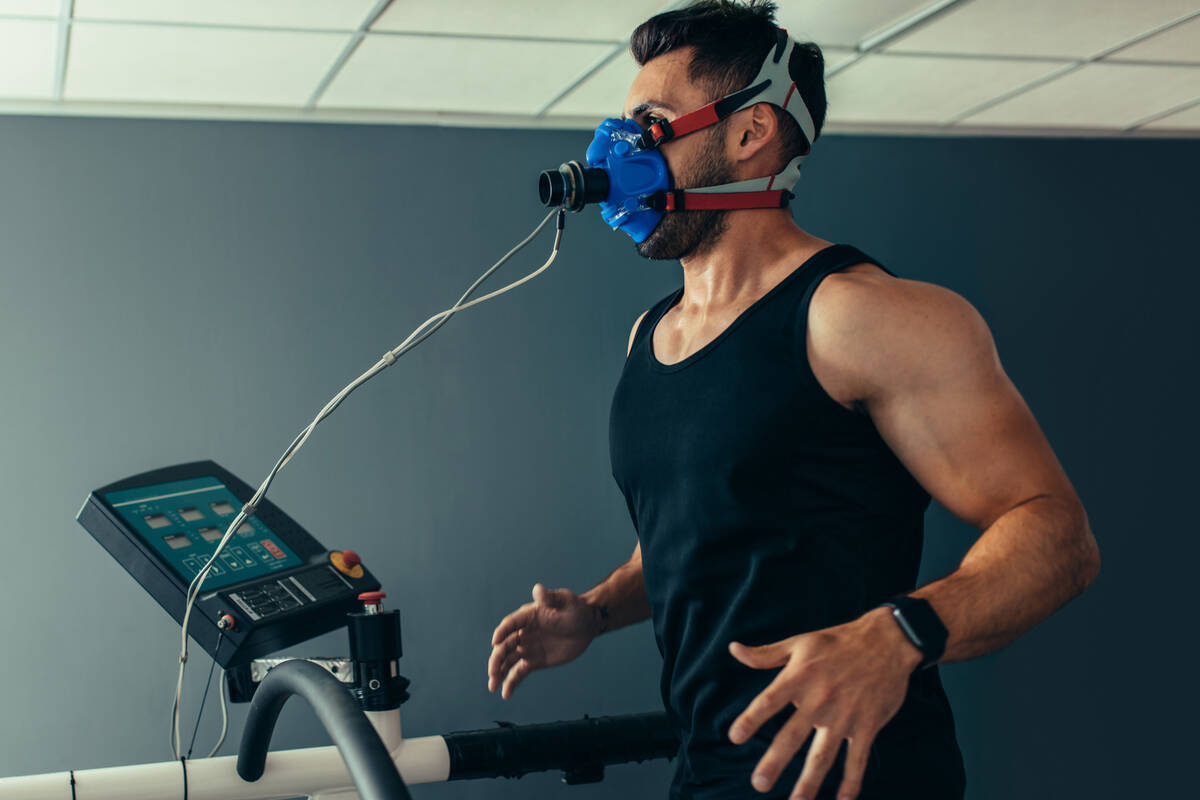
During the test, the person wears a breathing apparatus while running on a treadmill or biking on a stationary cycle. Gradually, the exercise protocol becomes more difficult, such as increasing speed, grade or pedaling resistance. They’re instructed to exercise as hard and for as long as they feel like they physically can.
The equipment then captures the peak volume and flow rate of air being inhaled, later converting that data into the maximal volume of oxygen consumed and the rate of energy expenditure.
The results give the participant a baseline value. For instance:
■ If a person is more sedentary, their baseline may be in the 20s (20 milliliters/kilogram/minute — ml/kg/min) of peak oxygen consumed.
■ For someone who’s fairly active — maybe participating in a recreational activity coupled with some strength and cardio training — their score may be in the 40s.
■ Those with a VO2 max in the 70s probably are elite-level endurance athletes.
■ Elite cross-country skiers may have a VO2 max score in the 80s and possibly even 90s (80-90 ml/kg/min).
Thousands of published studies support the finding that cardiopulmonary fitness is associated with reduced risk of cardiovascular disease, obesity, sleep apnea, metabolic syndrome and a number of other chronic health conditions, in addition to reduced risk for all causes of mortality.
Your VO2 max isn’t static. It can be improved with consistent exercise or training.
For example, someone who’s inactive can use their baseline values as a starting point. Working with a trainer or other fitness professionals, they can build a cardiopulmonary workout program using the most effective strategies to improve their cardiopulmonary fitness.
Doing cardiovascular exercise three to four days a week may improve their VO2 max by 20 percent to 30 percent over three to six months. The key is exercising regularly, and as fitness improves, gradually push the limits. This also can be done by adding high-intensity intervals to a program.
Those with higher VO2 max scores to start with will have less room for improvement, since they’re already at a higher fitness level. Genetics also play a role in aerobic fitness.
Athletes are the most common participants in VO2 max tests. They’re usually familiar with the test and how the measurement can be used to enhance their performance. This objective feedback is one way to help them measure progress and shape their training regime. For example, they may map out their training sessions based on what percentage of their VO2 max they want to work at that day.
People who have had heart attacks or heart surgery typically enroll in a cardiac rehabilitation program. This often involves a stress test with cardiovascular function measured in real time by an electrocardiogram (ECG) unit. Throughout their rehabilitation, the test provides feedback for exertion levels, which also helps them rebuild their cardiopulmonary fitness. While not a VO2 max test, it encourages similar behavior of consistent, progressive physical activity.
Wearables, such as smartwatches, can provide good feedback on heart rate and regular exercise outputs. However, they aren’t sophisticated enough yet to reliably measure VO2 max.
But people also have a built-in measure of fitness. You know when you get out of breath and tired, whether it’s on a long walk, climbing stairs or shooting hoops. This knowledge is subjective and doesn’t provide hard numbers, but it can be a useful guide as you work to improve your fitness.
For instance, you may be winded after climbing a flight of stairs. You start moving more, walking for 30 minutes rather than 15, notching up your walking speed or walking a more challenging route. After a few weeks, climbing those stairs might not be so hard. You know your cardiopulmonary fitness has improved, but you don’t know by how much.
Some people want to see the hard numbers to confirm how they feel. That’s what a VO2 max test can provide.
Andrew Jagim specializes in sports medicine with the Mayo Clinic Health System in Wisconsin.