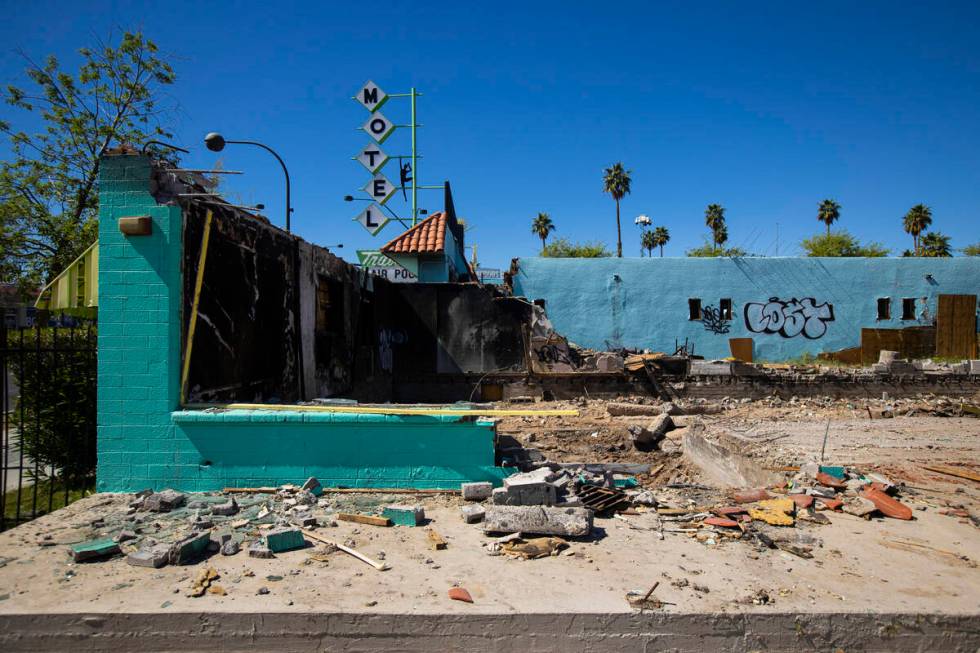
After ex-Zappos chief Tony Hsieh died and left vast real estate holdings in downtown Las Vegas, Shalimar Cabrera thought of one use for the motels he owned.
Cabrera, who works in Las Vegas for a veterans-support group, wondered if Hsieh’s boarded-up Fremont Street motels could be turned into housing for the homeless.
Las Vegas developer Sam Cherry figured the motels could be renovated and given a hipster vibe. And local developer J Dapper saw the history and charm in the mid-century structures.
“They could have been pretty cool,” Dapper said.
But after fires, squatters and other problems turned the long-shuttered motels into blighted eyesores, work crews have now demolished the buildings, wiping away any chance of preserving a stretch of old Las Vegas that fell into steep disrepair.

America’s casino capital is not known for historic preservation. Numerous hotels have been imploded over the years, often in early-morning parties with fireworks and masses of people gathering to watch and cheer the destruction. Also, older homes and commercial buildings in Southern Nevada can become rundown, especially if they’re empty, which leaves them prone to vagrants moving in and trashing the place.
But it’s another question whether it would have made sense financially to rehab Hsieh’s old motels — given how much this would have cost if the buildings could even be salvaged, and if tourists would pass on staying in action-packed casino districts for vintage motels without much right nearby.
‘Raze the motels to help make the community safer’
Paige Figanbaum, executive director of the Nevada Preservation Foundation, figured Hsieh’s former motels could have been part of a heritage-tourism corridor along Fremont.
Figanbaum, for one, said in an interview before the demolitions that the teardowns would be “devastating,” noting it’s not common in Las Vegas to have buildings with that much history.
She also said that it was “disappointing” to see the motels deteriorate.
Dapper, who has renovated older buildings in the downtown area, said that Hsieh’s team proved they could salvage decades-old motel properties.
He pointed to Fergusons, which Hsieh redeveloped into a commercial complex with retailers, a coffee shop and more.

Dapper also cited the Downtowner, which underwent a $2.5 million renovation several years ago and boasts “retro charm with modern essentials.”

Plus, Dapper noted that downtown Las Vegas already has numerous empty lots.
“What do we not need more of? More vacant land,” he said.
Hsieh’s former side venture DTP Companies told the Las Vegas Review-Journal in November that ongoing vandalism and related fires had “impacted the structural integrity of the buildings, making them potentially unsafe.”
After discussing the properties’ condition with the city and exploring available options, DTP decided to “raze the motels to help make the community safer and more attractive to residents, business owners, patrons and future developers,” it said.
Attorneys for Hsieh’s estate declined to comment for this story.
‘Offensive odors’
Hsieh, the former CEO of online shoe seller Zappos and face of downtown Las Vegas’ economic revival, died in 2020 at age 46 from injuries suffered in a Connecticut house fire. He was unmarried, and his father has been managing his estate through a probate case in Clark County District Court.
Hsieh left behind a vast portfolio of office buildings, apartment complexes, retail properties and other sites downtown. He assembled the holdings through a $350 million side venture originally called Downtown Project, becoming a one-man redevelopment engine for a long-neglected part of the city.
Hsieh’s portfolio included several old motel properties. And since his death, city records show, the shuttered buildings drew vagrants, were torched in fires and had piles of trash.

Las Vegas officials deemed several of his former motels “nuisance” properties and told management to secure access points, remove garbage and graffiti, not allow homeless people on-site and, in at least one case, remove all “offensive odors,” city records show.
Some of those buildings, including the one with the foul smell, had since been torn down. But until recently, others were still standing.

This past December, the city issued demolition permits for Hsieh’s former motels along the north side of Fremont between 11th and 14th streets.
Buildings previously known as Alicia Motel, The Gables and Valley Motel are now gone, and two buildings that previously comprised the Travelers motel were partially demolished as of Wednesday.
‘Severe fire damage and could collapse’
Landlord David Charron, whose commercial property on Fremont Street is home to the popular cafe PublicUs and other tenants, told the Review-Journal last year that tearing down the motels without a plan for the sites would make the area look desolate.
But the situation at the time didn’t help either, he noted.
“The more they sit, the more dilapidated they get,” he said.
City officials reported in 2021, for instance, that squatters were entering the former Valley Motel from the alley behind it. Then, in 2022, they reported that a fire next door, at the former Gables motel, had spread to the building.
And early last year, city officials reported that another nearby former motel was a “public nuisance” and that its roof had suffered “severe fire damage and could collapse.”

Hsieh’s former motels were apparently made of concrete block or brick, and despite suffering fires, the buildings did not burn to the ground.
Neil Opfer, associate professor of civil and environmental engineering and construction at UNLV, said that concrete block is fire resistant but can lose structural integrity in a blaze.
He also indicated that, in general, if a building is badly damaged in a fire, the repairs may involve structural work that requires meeting newer building codes.
If someone wanted to remodel an older property, they may be better off just tearing it down and building something new, Opfer said, citing the potentially mounting costs of a renovation.
‘Not really the Vegas M.O.’
In Las Vegas, developers have a long track record of imploding older hotels to clear space for bigger, flashier resorts.
Palm Springs, California, by comparison, is known for having stylish, mid-century motels with a distinct retro feel.
Town & Desert Hospitality founder Dave Dean owns mid-century motels in Palm Springs, including The Hideaway, Orbit In and Desert Riviera. He said they were all refurbished.

Desert Riviera, for instance, was built in 1951, has undergone many upgrades, and still has its “original mid-century style,” according to its website.
Dean said that Palm Springs has tight building-height restrictions and a design-review panel involved in developments, and that no city celebrates its architects like Palm Springs.
Saving old buildings is “not really the Vegas M.O.,” he said.
But he has noticed the glut of vacant lots in downtown Las Vegas and said that if someone decided to renovate a motel there, “you’re still kind of on an island.”
There are some places to eat and drink near Hsieh’s former motel sites, including popular tavern Atomic Liquors. But outside the casino-packed Fremont Street Experience, downtown’s nightlife scene is largely confined to a one-block stretch of Fremont several blocks away from the recently demolished motels.
‘Nostalgia can only go so far’
Dayvid Figler, a longtime local attorney and former host of the City Cast Las Vegas podcast, said his dad started visiting Las Vegas in the late 1950s or early ‘60s. He would drive in from Chicago to gamble and sometimes stayed at motels on Fremont Street.
As his father described it, the motels were a “clean place to flop,” Figler said.
Figler said it was sad that another pocket of Las Vegas has now disappeared without much protest. Overall, historic preservation is “far more sporadic” in Southern Nevada than in other metro areas, he said.
He pointed to some well-known efforts locally. The shell-shaped lobby of the long-gone La Concha motel, for instance, was moved to become the visitors’ center at the Neon Museum.
And the museum itself operates the popular Neon Boneyard outdoor exhibit space of signs from old Las Vegas casinos, motels and the like.
Still, Figler noted that vacant buildings can suffer from Southern Nevada’s brutal heat or get targeted by squatters. He also said that in Las Vegas — a relatively young and transient place where people celebrate old buildings getting toppled — it’s hard to get locals to care about preserving history.
“Nostalgia can only go so far in a few hands,” he said.
Contact Eli Segall at esegall@reviewjournal.com or 702-383-0342.
Safari motel conversion
The late Tony Hsieh’s former motels weren’t the only buildings on Fremont Street to fall into disrepair.
But down the street from his old holdings, another rundown motel on Fremont was repurposed in recent years.
The Safari, which was not owned by Hsieh, had a history of violent crime, drug use, health violations and fires, the Las Vegas Review-Journal previously reported.
Now, the property offers short-term housing and services for people who are homeless or at risk of becoming homeless.
Officials held a ribbon-cutting ceremony for the facility in spring 2023, after Clark County allocated $4 million in program funding for two years, with the potential to extend it for an additional three years.
The county contracted with homeless-prevention group U.S. Vets to operate the social services at the property, 2001 Fremont St.
Known as a BETterment Community, it has classes and case management and provides boarders with basic needs, including food, clothing and fully furnished apartments, said Shalimar Cabrera, national director of executive leadership with U.S. Vets.
Overall, it has up to 51 beds and offers 90-day stays, she said.
U.S. Vets doesn’t own the building and didn’t take part in the renovations, Cabrera said. But as she described it, the motel needed extensive work.
She said the Safari was previously boarded-up and uninhabitable, had been occupied by squatters, and needed plumping and roof repairs.
“Every unit had to be completely gutted,” she said.
— Eli Segall