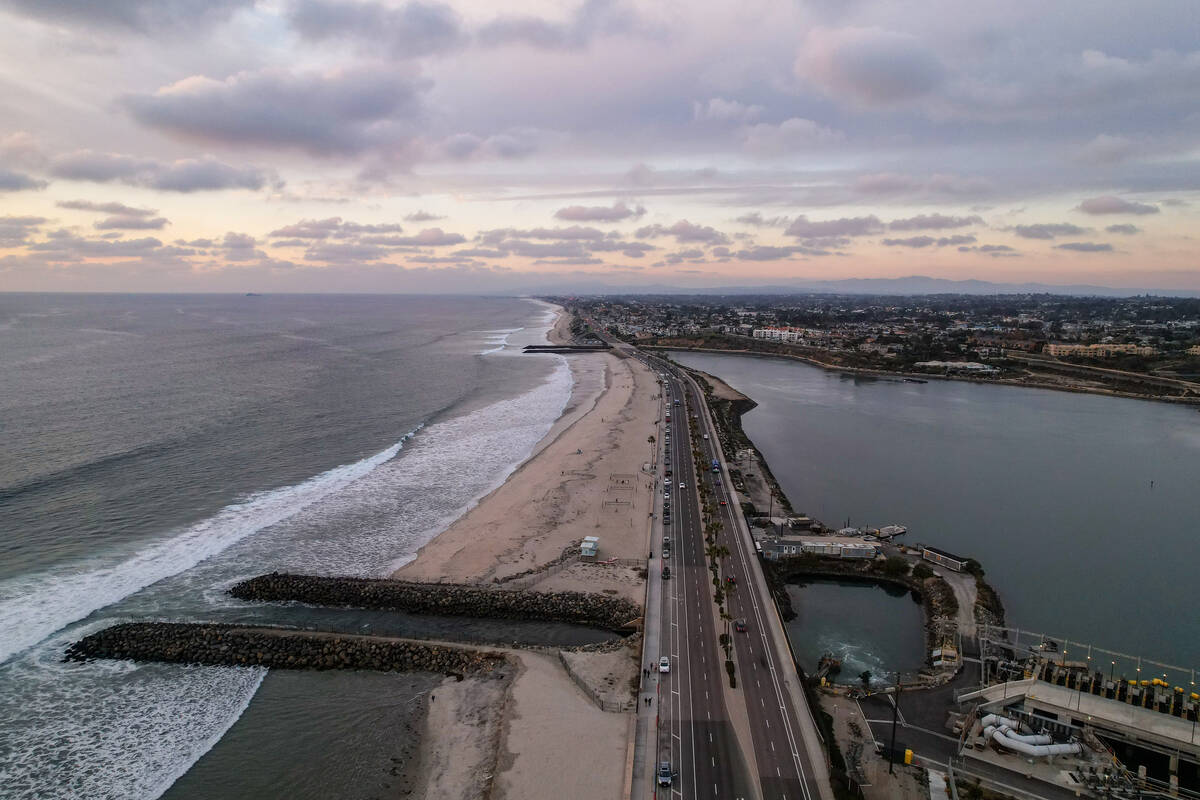
Southern Nevada is now looking to the Pacific Ocean to ease its water woes.
In a vote Thursday, the Southern Nevada Water Authority board approved a memorandum of understanding that allows General Manager John Entsminger to hammer out a first-of-its-kind water transfer deal with the San Diego County Water Authority. In a region where growth could outpace permanent water supplies in the next few decades, that matters.
The terms are far from certain. But California would leave water in Lake Mead that Nevada could use in exchange for compensation; California would fill that gap with ocean water treated by the Carlsbad Desalination Plant.
“It’s a pellet of the silver buckshot, but it’s not a silver bullet,” said Entsminger, in a Monday interview.
However, if a contract materialized, it could revolutionize what water managers thought was possible, effectively adding permanent water to an arid region’s portfolio amid what is on track to be the poorest runoff season on record in the Colorado River Basin.
How much water?
Entsminger declined to share how much water Southern Nevada could stand to gain, saying that the number could vary year to year depending on the changing water demands of San Diego County.
The annual capacity of the plant is 56,000 acre-feet per year, said Dan Denham, general manager of the San Diego County Water Authority, in an interview. Within existing permits, that figure could grow to 62,000 acre-feet per year if one of the interested states helps fund the plant’s expansion, he said.
An acre-foot of water, roughly 351,850 gallons, is enough to serve two single-family homes for a year, by most estimates.
Nevada’s full yearly allocation from the Colorado River — the smallest of any state — is 300,000 acre-feet. Last year, after cashing in credits from water recycling, Nevada’s consumptive use came in at 198,000 acre-feet in total, a number that only represents water that wasn’t returned to Lake Mead.
Under a current proposal from the Lower Basin states of Nevada, California and Arizona, the Las Vegas metro area could voluntarily give up at least 50,000 acre-feet or as much as 100,000 acre-feet of its water in both 2027 and 2028.
Denham said his agency is equipped to eventually pass off all of the plant’s water via a water transfer if a deal surfaces, but the volume of water that could be included depends on several factors, including the length of the agreement. Arizona officials are in early talks to benefit from some of the water, too.
Negotiations shouldn’t take more than a year, Denham estimates, though how current interstate talks go as the federal government prepares to intervene in a seven-state deadlock could dictate the speed.
“I don’t think hydrology is going to wait; we can’t wait for the next snowpack year,” Denham said. “It has to happen faster. This is the test case.”
About 60 percent of San Diego County’s water supply comes from the Colorado River Aqueduct, a 242-mile pipeline that moves water from Lake Havasu to Southern California. As population growth has stagnated and even more supplies became available with an investment in water recycling, Denham said his region’s supply now outweighs demand.
While the amount of water that could come from a desalination water transfer may seem small compared with California’s larger 4.4-million acre-foot annual share of the river, Denham said it could have an outsized impact for Southern Nevada.
“Small amounts do make a difference to agencies of our size,” Denham said.
Focus on water augmentation
The news of the potential deal comes at a time when the Trump administration has directed states to take inventory of possible water augmentation projects, or those that add water to the system, such as desalination.
Arizona negotiator Tom Buschatzke revealed at a public meeting this month that his state is working on a list of possibilities.
Simultaneously, the governors of the seven states have asked Interior Secretary Doug Burgum to release the remaining $550 million from the Inflation Reduction Act — a 2022 law that represented the largest investment in climate change mitigation in U.S. history. The Trump administration has clawed back that funding, labeling it unnecessary spending.
The governors don’t specify any one project it could fund but say the money is necessary to provide a buffer for state economies as they face operational changes.
Separately, a group of water users and nongovernmental organizations from across the Colorado River Basin sent a letter to Congress on May 13, calling for at least $2 billion in federal investment in drought relief.
Someone who has been one of the loudest advocates for desalination is Pat Mulroy, who served as the first general manager of the Southern Nevada Water Authority from the early ’90s until 2014.
In an interview, Mulroy reiterated that conservation alone isn’t enough. Banking water when it’s available will become increasingly important, she added.
“We’ve become a one-trick pony, and that’s not how we’re going to solve the problem,” she said.
Mulroy said that beyond funding, California-specific regulatory challenges and lawsuits are a hindrance to seeing more desalination through. Between 2006 and 2012, environmental groups such as the Surfrider Foundation filed multiple lawsuits and permit appeals, alleging harm to marine life and causing significant project delays.
The big price tag for building desalination plants shouldn’t scare off water managers, Mulroy said. She pointed to the financing structure of the original Lake Mead intake for Southern Nevada, a 30-year loan.
Going forward, Mulroy said key considerations of the negotiation include figuring out cost and what levels of government must approve a final deal. Even if it ends up expensive, Mulroy contends that the days of cheap, new water supplies are gone.
“Our systems have to be flexible, and they have to be able to adapt,” Mulroy said. “The only way they can is by having as many options for water resources as we can possibly get.”
Southern Nevada hit with cease-and-desist
In a move Entsminger called puzzling, the memorandum has received pushback from some residents, namely the Water Fairness Coalition organization that has advocated against conservation measures that its members say are unfair and unequally applied.
The group sent officials a cease-and-desist letter, authored by Las Vegas attorney Sam Castor. He is leading two active lawsuits against the Southern Nevada Water Authority over its excessive use charges levied against residents and the implementation of a 2021 law outlawing the use of Colorado River water for decorative grass.
In the letter, Castor argues that the agency is acting outside of its legal authority, and instead the Colorado River Commission of Nevada would be the appropriate party to permit a deal, according to existing laws.
“If the SNWA Board authorizes Mr. Entsminger to execute the MOU and he uses that improper authority, the WFC will challenge that conduct in the courts and seek to invalidate it,” he wrote.
Entsminger, during Thursday’s board meeting, said he was confused by public comment from Castor and the coalition.
“Nothing in this MOU contemplates transferring any portion of Nevada’s water rights to anyone else,” Entsminger said. “I find it semi-ironic that a number of speakers said what we need to be doing is out there fighting to get more water. This is about getting more water.”
Asked in a follow-up interview about why her organization is fighting against a desalination deal, coalition founder Laura McSwain said she is not opposed to the idea of the transfer.
Rather, McSwain said it’s important to hold the agency to its charter and the legal framework of the 1922 Colorado River Compact. She believes much of the agency’s punitive approach to conservation measures has been unlawful.
It shouldn’t be an either-or situation, McSwain said, as to whether Nevada gets to keep the water it has while building in new supplies like the desalination water transfer. In her view, Entsminger should be more aggressive in asserting that Nevada shouldn’t take voluntary cuts to its share of the river following decades of proactive conservation.
“(Entsminger) has been willing to negotiate away what I consider state assets,” McSwain said. “I want to make sure that the law is actually absolutely followed and the community has every opportunity for visibility to what is taking place.”
Contact Alan Halaly at ahalaly@reviewjournal.com. Follow @AlanHalaly on X.