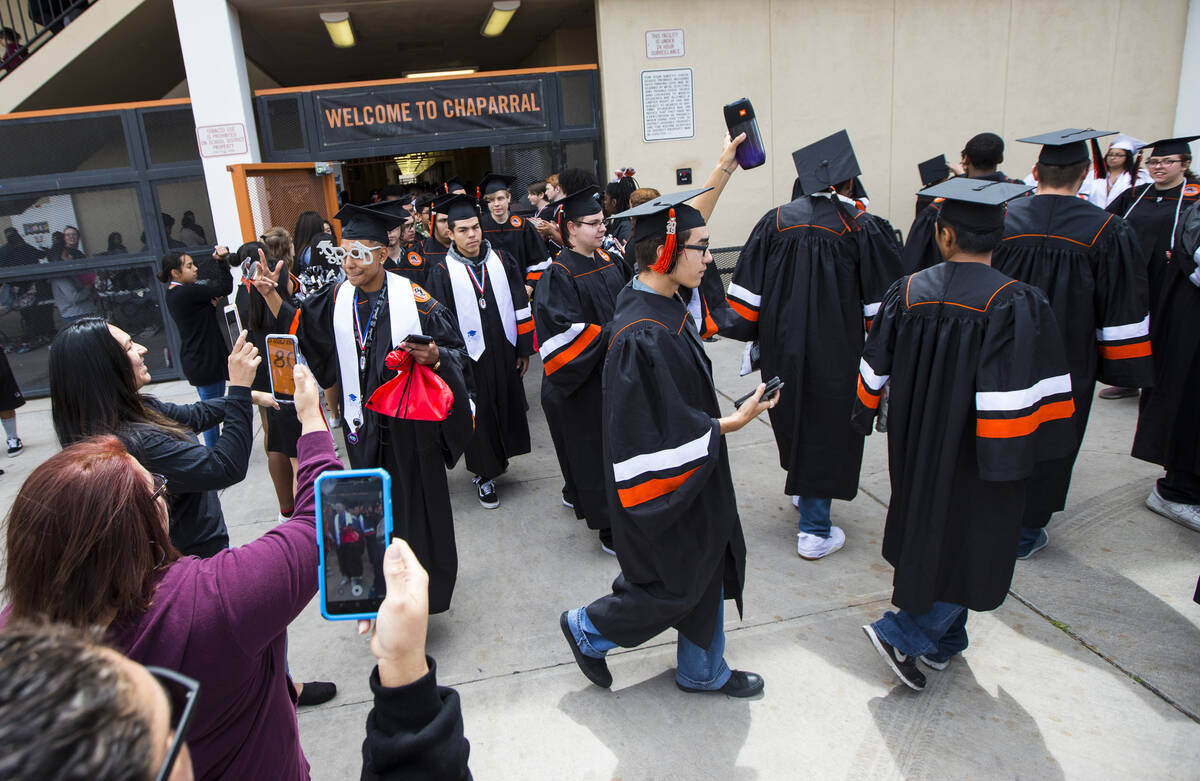
The Clark County School District has updated its graduation regalia policy nearly one year after it was sued over its former policy.
The new policy states that students can wear up to five stoles and “any regalia, decorations, or adornments that lay flat on the cap and do not exceed the dimensions of the cap” at their graduation ceremony.
It also creates a new optional preapproval process for wearing cap and gown decorations, eliminating the former mandatory approval process. The new policy was approved in the consent agenda at Thursday’s Clark County School Board meeting.
Updates to the graduation regalia policy come almost one year after the American Civil Liberties Union of Nevada sued the district on behalf of former CCSD student Corie Humphrey.
The lawsuit indicated that Humphrey, then a senior at East Career and Technical Academy, was told she couldn’t wear a stole with “Black Girl Magic” written on it. Humphrey wanted to wear the stole to represent her Black culture, according to the lawsuit.
The original complaint also described six CCSD seniors, including Humphrey, in the ACLU’s emerging leaders program, whose schools had varying policies regarding what they could wear and what happened if they wore an item deemed inappropriate. The ACLU had asked for a single policy for all school district students.
In an emergency ruling last May, a federal judge said graduating students have the right to wear certain attire that represents “lawful, protected forms of expression.”
The district’s updated policy also stipulates that regalia “must not be lewd, obscene, vulgar, profane, promote violence, promote the use of illicit drugs, constitute harassment, bullying, or discrimination, or create a substantial disruption” of the graduation ceremony.
In a statement, ACLU of Nevada Executive Director Athar Haseebullah said his organization will monitor the enforcement of the changed policy.
“It would be prudent for administrators to understand that violations of the First Amendment will not be treated with understanding moving forward and will result in new legal actions,” Haseebullah said. “Students and families deserve to be able to mark graduation in a way that honors their culture and their journeys without school officials trying to be the arbiters of the First Amendment.”
What is the preapproval process?
The district now strongly recommends that graduating students submit any regalia, decorations or adornments on caps and gowns to their school principal or their designee for review and approval at least 20 school days before their graduation ceremony.
The reviewer will approve or deny the regalia within 10 school days of receiving the request from a student, according to the new policy. If the regalia is denied, the policy states, the reviewer must file a form including the reason for denial and provide the form to the student and their parent or guardian. Students can appeal a denial no later than five school days prior to the graduation ceremony, per the policy.
Should a student attend their graduation ceremony wearing items that have not been preapproved and do not conform to the new policy, the student may be required to remove the items or face being removed from the ceremony, according to the policy.
Contact Spencer Levering at slevering@reviewjournal.com or 702-383-0253.