
Want unlimited access to top ideas and insights? Subscribe Now
The mortgage industry has invested a huge amount of time and money to create products for tapping the vast amount of home equity equity inside the 145 million residential homes in the US. Looking at the HMDA data, close-end second (“CES”) liens accounted for almost 25% of all residential mortgage loans in 2023, but the small size of the loans means that the unpaid principal balance is more like 10% of total volumes.
Another important change in the world of CES has been the volume of these loans that have been securitized, both into the private market and also agency RMBS.
“For second liens, which include home equity lines of credit and closed-end second liens,” Kroll Bond Rating Agency reports, “issuance is projected to reach $21 billion in 2025 (up 42% YoY), extending the momentum from 2024 as homeowners continue to tap equity amid limited refinance incentives.”
A number of issuers have come to the securitization market in the past several years, including JPMorgan, Rocket Mortgage, Verus, Crosscountry and Bravo. More, warehouse lenders and repo counterparties are accepting pools of CES liens for financing, further helping the economics of a product that is basically a loss leader. If the industry does $21 billion in CES liens in 2025, that is a rounding error in a market estimated to do $2 trillion in total 1-4 family originations. Yet many market observers are optimistic about future growth potential.
“With close to $35 trillion of homeowner equity in residential real estate and many homeowners locked into low-rate first mortgages, HELOCs and home equity loans have become the product of choice for many homeowners,” said Marina Walsh, CMB, MBA’s Vice President of Industry Analysis noted this past July. “Lenders in our study expect year-over-year growth of almost 10 percent for HELOC debt and 7 percent for home equity loan debt in 2025.”
Walsh noted that the reasons for tapping home equity are shifting. In 2024, approximately 39 percent of borrowers cited debt consolidation as the reason for applying for a home equity loan, compared to 25 percent two years prior. Those borrowers who indicated home renovations as their reason for usage dropped to 46 percent of volume, compared to 65 percent in 2022.
But Walsh added: “While there are additional opportunities in this space for lenders, there are also challenges. For example, just 50 percent of home equity applications are closing, and turn times are averaging 39 days. Automated valuations and decisioning, integrations with mortgage platforms, and accessible self-service options are a few ways lenders intend to increase efficiency and reduce costs.”
The statistics provided by Walsh suggest that CES liens are very expensive products given the small loan size. The low close rates and long turn times are not encouraging, but the CES liens do help to fill the mortgage pipeline. Yet it needs to be said that independent mortgage banks are not the natural originators of second-lien mortgage products.
Traditionally commercial banks have been the primary provides of home equity loans in the form of revolving credit lines or “HELOCs” secured by a second lien. These are essentially revolving credit lines with a subordinated security interest in the house, usually behind a closed end first lien mortgage. The rate of utilization of bank HELOCs vs available credit is at a 35-year low, according to data from the FDIC. Total HELOCs owned by banks were just below $300 billion as of Q3 2025.
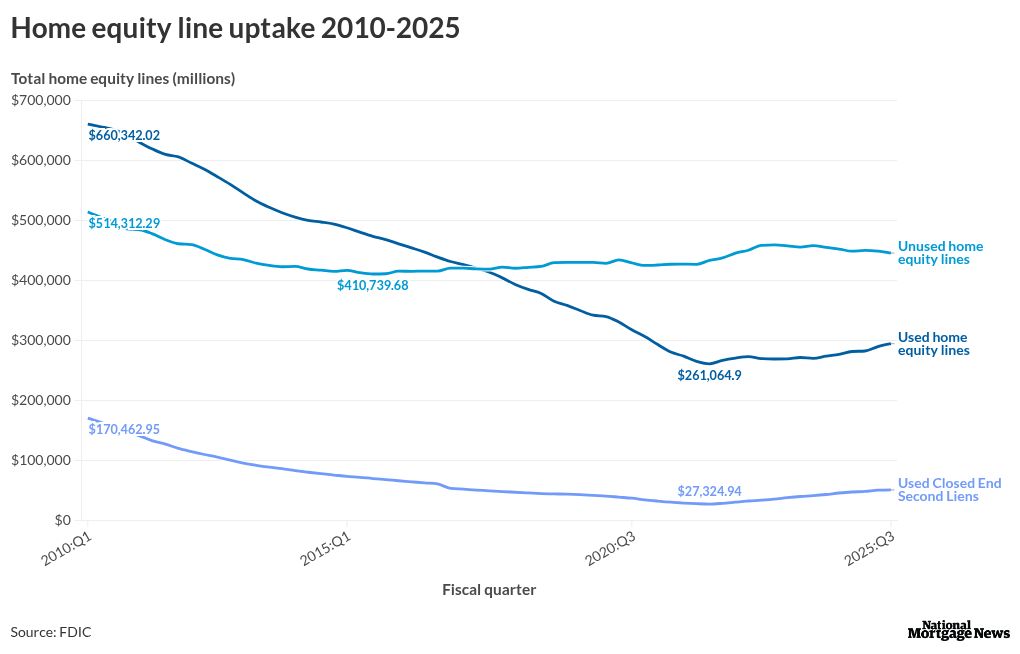
As you can see in the chart, both CES liens and HELOCs originated by banks have been growing since 2021, but just barely. Why is the growth of HELOCs, CES liens and other home equity products like reverse mortgages so slow? In you adjust the numbers for inflation, utilization is falling even more rapidly than the nominal data suggests.
One big reason for the slow growth of home equity products is regulation. The Dodd-Frank law closed loopholes that previously made risky second mortgages profitable. Lenders now have much tighter underwriting standards and documentation requirements (minimum credit scores, stable income) for home equity loans.
Cautious lender and borrower behavior is another factor behind the low growth of home equity products. Many homeowners remain wary due to the painful lessons of the housing crisis, where many borrowers ended up “underwater” (owing more than their home was worth). Also, second liens made loan modifications difficult and sometimes forced people out of their homes.
Another issue is sticker shock, with many consumers looking for lower interest rates on CES liens and HELOCs, but the second position for these products means that they have higher risk and this higher coupon rates. Bank Rate notes that rates on home equity products are not as favorable as primary mortgages or even refinance rates, generally running a couple of percentage points higher.
One firm that is bullish on home equity is Finance of America, a leading provider of home equity-based financing solutions for retirement using reverse mortgages. FOA saw funded volumes rise to $1.8 billion in the first nine months of 2025, representing a 28% increase from the same period in 2024.
FOA just announced the acquisition of the reverse mortgage servicing portfolio and other assets from PHH Mortgage Corporation, a subsidiary of Onity Group. The acquisition makes FOA roughly equal in terms of market share with reverse mortgage leader Mutual of Omaha.
In August 2025, FOA announced that it repaid $85 million of higher cost working capital facilities and entered into an agreement to repurchase the entirety of Blackstone Group’s equity stake. Blackstone was the majority shareholder, with a roughly 70% ownership stake when the company went public in 2021. The stock of FOA has soared over 300% during 2025, but sold off after the Blackstone announcement.
Despite the exit by Blackstone, institutional investors and private equity investors collectively own a large percentage of the company’s stock. Clearly a number of investors and financial institutions remain bullish on home equity products such as reverse mortgages, yet the attractive demographics and other positive factors have not served as a catalyst for strong market growth across the industry overall.
Lenders from Chase to SoFi Technologies to Rocket Mortgage have poured significant resources into home equity loans, but the fact remains that many loan officers in the industry would rather spend their time on larger purchase mortgage loans or refinance opportunities. As one veteran LO told NMN, “If interest rates we lower and market volumes were stronger, nobody in my office with bother with second liens products.”
